Fiber Optic Pool Lighting: The 2026 Buyer's Guide to Cost, Safety & Laser vs LED
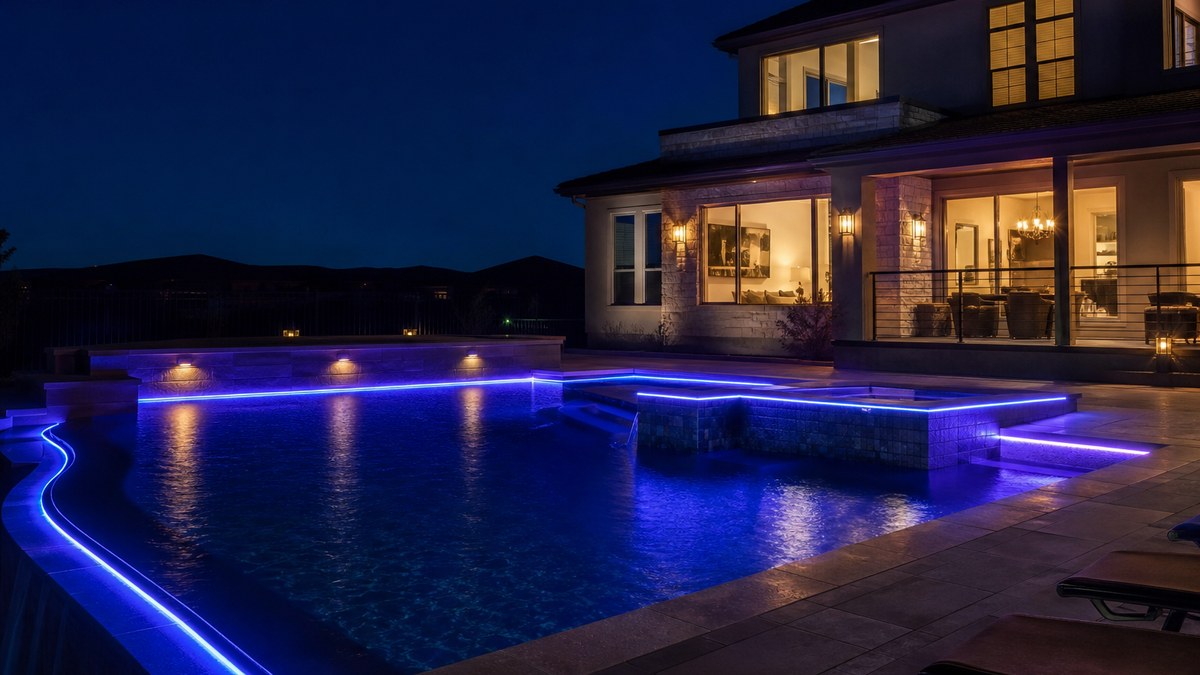
Fiber optic pool lighting is the only way to light a pool without putting electricity anywhere near the water. The fiber carries light, not current, so the part that touches the water can never shock anyone. For years, the trade-off was brightness: older fiber systems looked dim and faded along long runs. Laser-powered 360° fiber changes that math.
This guide explains how fiber optic pool lighting works, what it costs in 2026, how laser fiber compares with LED pool lights and traditional fiber, and how to pick the right system for a residential pool, a resort, or a commercial water feature. We include our real system pricing, so you can budget with confidence instead of guessing.
Fiber optic pool lighting sends light from a remote illuminator through flexible fiber cable to the pool. There is zero electrical current in or near the water.
- Safety: all electrical parts stay in a remote unit away from the pool
- Look: 360° side-glow fiber outlines the pool with a continuous line of color, not spots of light
- Laser vs LED: laser-powered fiber delivers much richer color and runs up to 200+ meters from one unit
- 360 Fiber system pricing: $7,995 (Residential Starter), $9,995 (Professional Pool System), $14,995 (Commercial / Architectural)
- Maintenance: no bulbs in the water; service happens at the dry, accessible laser unit
How fiber optic pool lighting works
Every fiber optic lighting system has two main parts: a light source, called an illuminator, and the fiber that carries the light. The illuminator sits in a dry, ventilated spot such as the equipment pad, a pool house, or a utility room. The fiber runs from there to the pool, where it is installed in the perimeter track, under the coping, along steps, benches, and water features.
There are two kinds of fiber:
- End-glow fiber emits light only at the tip. It is used for "star" points in pool floors and spas, and for starlight ceilings.
- Side-glow fiber emits light along its whole length. It creates the continuous glowing outline around the pool edge that most owners want.
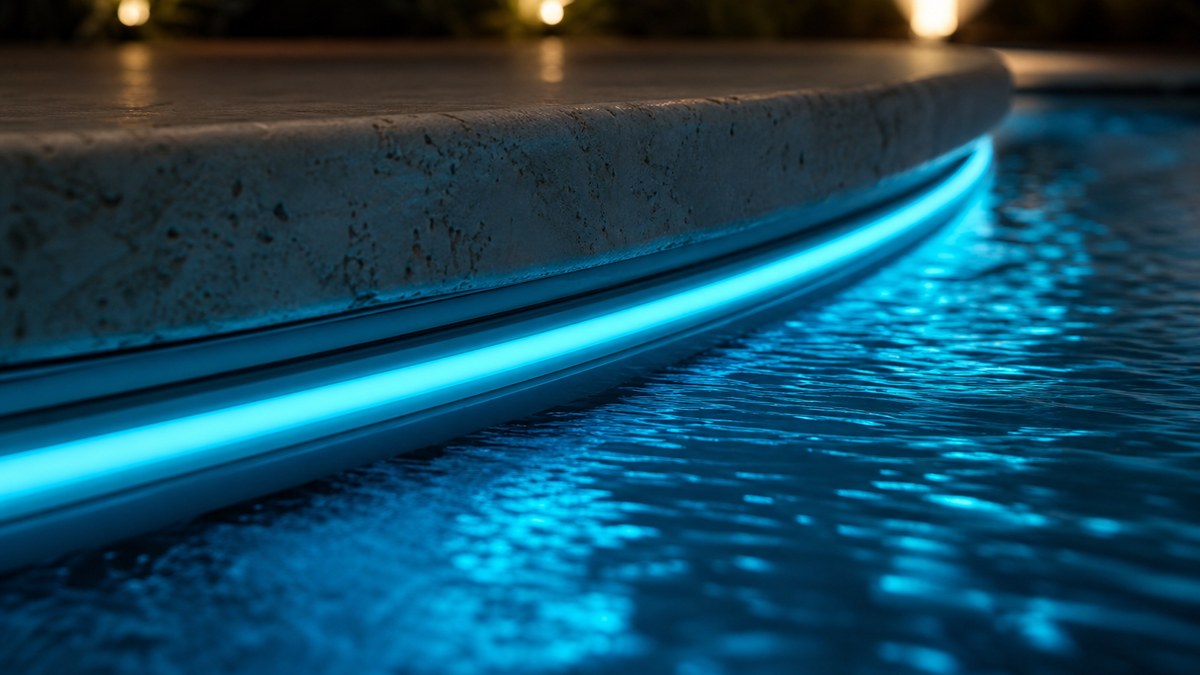
Our 360° fiber is a side-glow cable designed to light up evenly around its full circumference, so it looks like a solid line of light from any angle. It can bend around curves, follow free-form pool shapes, and be cut to length without damage.
What makes laser-powered fiber different
Traditional fiber optic pool lighting used halogen or metal halide illuminators, then LED illuminators. The weakness was always the same: light fades the farther it travels, so long runs looked bright near the source and dull at the far end. Colors often looked washed out.
Our 360° system uses a patent-pending laser light source instead. Laser light is far more concentrated, which is why our system can drive fiber runs of 200+ meters from a single unit and produce 3x better color saturation than LED ribbon. The technology was named Best New Product at LDI 2024 and was selected by Genesis for its GV80 luxury vehicle campaign. Learn more about the 360° laser technology.
Because the laser unit can drive such long runs, one unit can outline a large residential pool and its spa. That means fewer light sources, fewer electrical connections, and a simpler install than multiple underwater fixtures.
Safety: the biggest reason owners choose fiber
Conventional underwater pool lights sit in a wet niche in the pool wall with a cord running back to a junction box. The National Electrical Code (NEC Article 680) has detailed rules for these fixtures, including GFCI protection, bonding, and where the power supply can be located, because electricity and water are a dangerous mix. When fixtures age, seals fail, or installations are done poorly, the risk goes up.
Fiber optic lighting removes that risk from the water entirely. The fiber is glass or polymer that carries only light. There is no current in the cable, no heat at the pool, and nothing electrical to fail underwater. The laser unit still needs a proper electrical connection by a licensed electrician, but it lives safely away from the pool. We cover this in depth in our guide to the safest pool lighting.
That is why fiber optic lighting is a favorite for:
- Families with young children who use the pool every day
- Hotels, resorts, and HOAs that want to reduce liability around water
- Splash pads, fountains, and interactive water features where people touch the water
- Vanishing-edge and beach-entry pools where lighting runs right at the waterline
Laser fiber vs LED pool lights vs traditional fiber
Here is how the three main options compare for pool owners and builders.
| Feature | 360° Laser Fiber | LED Pool Lights | Traditional Fiber |
|---|---|---|---|
| Electricity in or near the water | None | Yes, in the wet niche | None |
| Look | Continuous glowing outline, 360° | Bright spots of light | Outline, often dim |
| Color quality | Very rich, saturated | Good | Often washed out |
| Run length from one source | 200+ meters | N/A (one fixture per spot) | Shorter; fades with distance |
| Heat at the pool | None | Some, at the fixture | None |
| Where service happens | Dry laser unit | In the pool wall | Dry illuminator |
| Shapes and curves | Bends, cut to any length | Fixed fixture positions | Bends |
| Best for | Premium pools, resorts, architecture | Budget general lighting | Older installs |
Many owners combine approaches: 360° fiber for the perimeter outline and water features, plus LED for general in-pool brightness. For LED options, see our best LED pool lights guide, and for design inspiration, our pool lighting ideas.
How much does fiber optic pool lighting cost?
Fiber optic pool lighting cost depends on three things: how many meters of fiber you need, how powerful the illuminator must be, and how complex the installation is. New construction is easiest because the fiber track can be built into the coping and walls. Retrofits are possible but may need coping work or surface-mounted track.
Here is our current 360 Fiber system pricing (early-bird pricing at the time of writing):
Residential Starter
- LF40 4-watt laser unit
- 50 m fiber optic cable
- RGB color controller
- Basic installation kit
- Setup guide & video support
- 1-year warranty
Professional Pool System
- LF40 4-watt weatherproof unit
- 100 m fiber optic cable
- Premium RGB controller
- Pool-specific mounting hardware
- Full installation guide & support
- 2-year warranty
Commercial / Architectural
- LF120 12-watt laser unit
- 200 m fiber optic cable
- DMX-compatible controller
- Multi-zone capability
- Custom color programming
- 3-year warranty
Prices are for the system (equipment, fiber, controller, and installation kit). Your pool builder or electrician's labor for installing track and connecting the laser unit is separate and varies by project. Every order is backed by a 30-day money-back guarantee. See full details on our system pricing section or ask about a custom configuration.
How to pick the right package
- Measure the perimeter. A typical backyard pool plus spa often falls in the 30–60 meter range. Add steps, benches, and water features.
- Residential Starter (50 m) suits smaller pools, spas, and courtyard water features.
- Professional Pool System (100 m) covers most larger residential pools, spas, and step lines, with weatherproof hardware.
- Commercial / Architectural (200 m) fits resort pools, lagoon pools, multi-zone projects, and building outlines with DMX control.
Get a free pool lighting consultation
Send us your pool size and photos. We will recommend the right system, fiber length, and layout.
Where fiber optic lighting looks best around a pool
Perimeter and coping
The signature look: a continuous line of color tracing the pool edge. Side-glow fiber sits in a track under the coping lip, so you see the glow but not the cable.
Steps, benches, and tanning ledges
Lighting each step edge improves safety at night and gives the pool a high-end resort feel.
Spas and spillovers
Outline the spa and the spillway to create a glowing waterfall into the pool.
Vanishing edges and water features
Fiber along a vanishing edge, sheer descents, bubblers, and fountains adds movement and color. Because there is no electricity in the fiber, it is ideal right where water flows. For specialist pool builders and fiber pool lighting installs, our network partner premium pool lighting focuses on exactly this.
Decks, landscaping, and the house itself
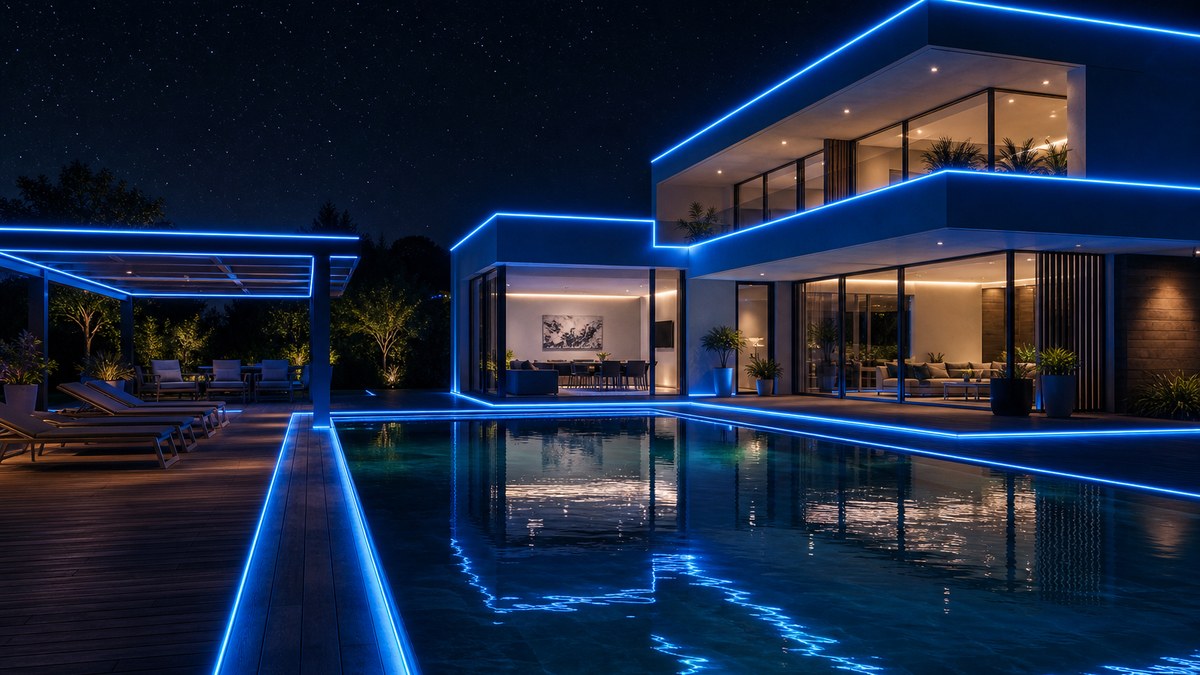
The same system can extend beyond the water: outline deck edges, planters, pergolas, and even the rooflines of the home or pool house. See how this works on larger buildings in our architectural building lighting guide.
Commercial pools, resorts, and outdoor buildings
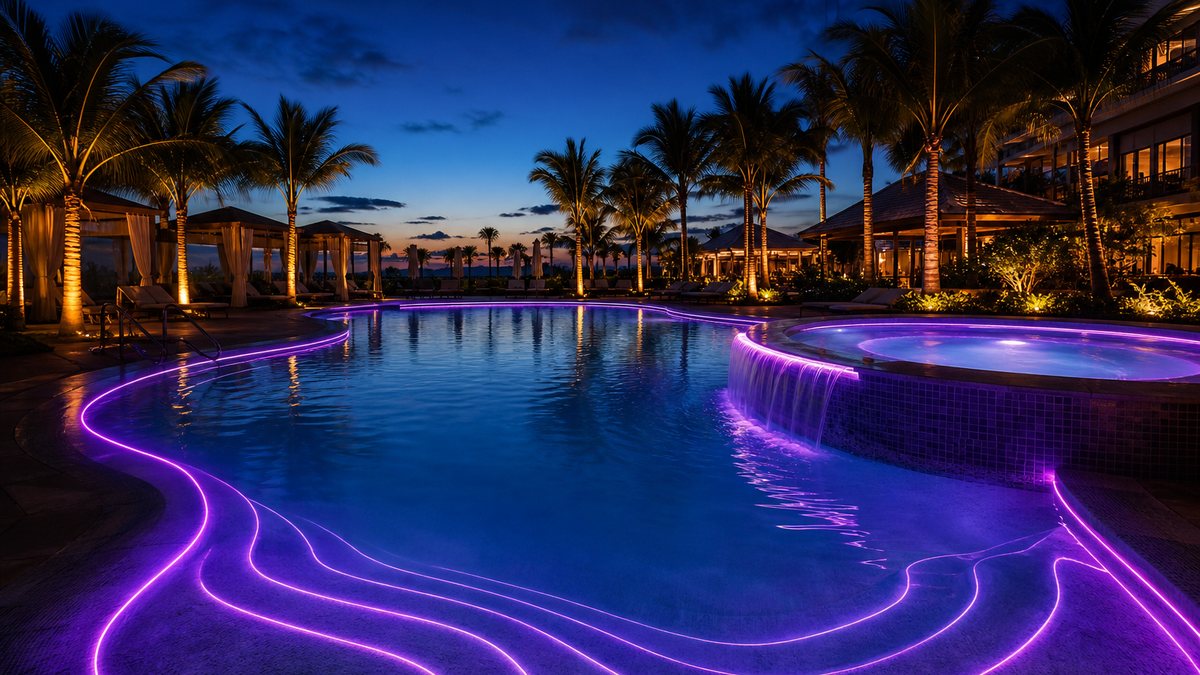
For hotels, resorts, casinos, HOAs, and restaurants, the pool is part of the brand. Laser fiber lets a property create a signature color look, change it for events and holidays with DMX control, and avoid underwater fixtures that need draining or diving to service.
The Commercial / Architectural system's 200-meter capacity and multi-zone control also make it a strong fit for building exteriors: rooflines, columns, canopies, signage frames, and facade details. We provide professional installation support for commercial projects nationwide through our commercial lighting services and our Luminance design-build program.
Installation: new build vs retrofit
- Plan the layout. Mark every line you want to light and measure total fiber length.
- Pick the laser unit location. A dry, ventilated spot near the equipment pad, within reach of the runs.
- Install the track. In new construction, the track is set in the coping or wall during the build. In a retrofit, it goes under existing coping or in a low-profile surface track.
- Pull and seat the fiber. The fiber is cut to length and pressed into the track.
- Connect the laser unit. A licensed electrician provides power to the unit, following local code.
- Program the colors. Set favorite colors, fades, and scenes on the controller.
The Residential Starter system is designed for confident DIY installers and comes with guides and video support. For pools and larger projects we recommend working with your pool builder, and we provide installation support and consultation. Pool owners in Texas can also tap our network, including Dallas commercial LED lighting and statewide Texas LED lighting.
If you are building a new pool, plan the fiber track before the coping is set. It costs far less to include it during construction than to add it later.
Maintenance and lifespan
Fiber optic pool lighting is low-maintenance by design. There are no bulbs in the pool to replace, no wet niches to reseal, and no need to drain the pool for lighting repairs. The fiber itself has no electrical parts to fail. Maintenance centers on the laser unit, which sits in a dry, accessible spot. Keep its vents clear, protect it from direct water, and keep the fiber track clean of debris.
Systems come with warranty coverage based on the package: 1 year (Residential Starter), 2 years (Professional Pool System), and 3 years (Commercial / Architectural).
Frequently Asked Questions
Is fiber optic pool lighting safe?
How much does fiber optic pool lighting cost?
Is fiber optic pool lighting better than LED?
Why was traditional fiber optic pool lighting dim?
How long can a fiber optic pool lighting run be?
Can fiber optic lighting be added to an existing pool?
Can I install a fiber optic pool lighting system myself?
Does fiber optic pool lighting need maintenance?
What colors can fiber optic pool lights show?
Is there a guarantee or warranty?
Light your pool with zero electricity in the water
Choose your system, or talk to us about a custom configuration for a resort, commercial pool, or building.
Related guides
Explore our lighting network: fiber optic star ceilings, Fort Worth LED lighting, Arlington LED services, Plano LED lighting, Irving LED solutions, wholesale LED solutions, modular building solutions, and modular structures in Dallas.