Pool Perimeter Lighting: 12 Side-Glow Fiber Optic Coping Ideas for 2026
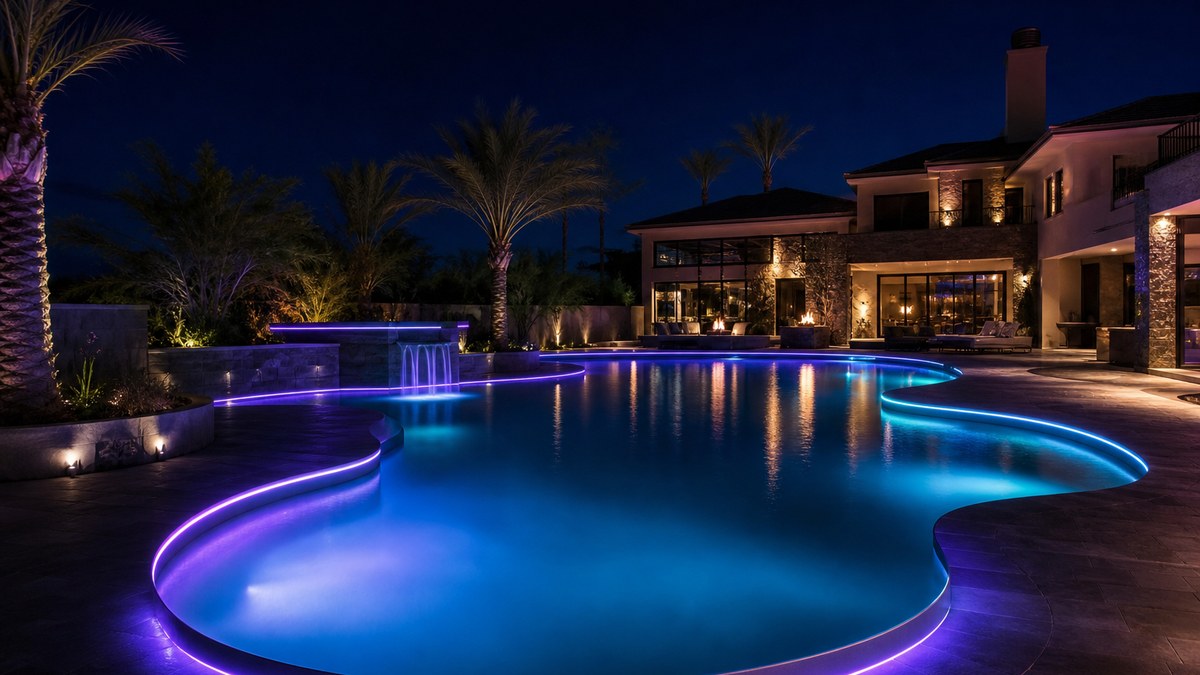
Pool perimeter lighting is the single design move that makes a backyard pool look like a five-star resort at night. Instead of a few bright spots in the pool wall, a continuous line of light traces the edge of the water, the spa, the steps and the deck. With side-glow fiber optic cable tucked under the coping, that line glows evenly all the way around, and there is no electricity anywhere near the water.
This guide is a design gallery and a buying guide in one. You will find 12 proven pool perimeter lighting ideas, how coping lighting is installed on new and existing pools, how laser fiber compares with LED strip and traditional fiber, which colors work best, and what a complete system costs. If you are a homeowner, pool builder or landscape designer planning a project, this is the page to bookmark.
The best pool perimeter lighting is a continuous line of side-glow fiber optic cable set in a track under the pool coping, powered by a remote light source in a dry location. It outlines the whole pool with color while keeping all electrical parts away from the water.
- Where it goes: under the coping lip, along steps, benches, tanning ledges, spa edges, spillways and deck borders
- Why fiber: zero electricity in the fiber, no heat, 100% waterproof fiber, and it bends around curves and freeform shapes
- Why laser: 360° laser fiber delivers 3x better color saturation than LED ribbon and runs 200+ m from one unit
- System pricing: $7,995 (50 m), $9,995 (100 m, most popular for pools) or $14,995 (200 m, multi-zone), early-bird pricing at the time of writing
- Best time to add it: during new construction or a coping remodel, but retrofits are possible
What is pool perimeter lighting and why it matters
Pool perimeter lighting is any lighting that follows the outline of the pool instead of lighting the water from a single point. Most pools are built with one or two underwater niche lights. They light the water, but they leave the edges dark and create hot spots near the fixture. Perimeter lighting does the opposite: it draws the shape of the pool, so the curves, the spa and the steps read clearly from the house, the patio and even from the street.
There are three main ways to light a pool perimeter:
- Side-glow fiber optic cable set in a track under the coping. A remote light source sends light through the fiber, which glows along its full length.
- LED strip or LED neon flex mounted under the coping or in a channel. It is low voltage, but it is still an electrical product sitting next to water and pool chemicals.
- Small point lights (end-glow fiber or mini LED fixtures) spaced along the edge. These create a string of dots rather than a line.
For the continuous, glowing outline most owners picture, side-glow fiber is the purpose-built option. If you want the full background on the technology, start with our fiber optic pool lighting buyer's guide.
Why the coping is the perfect place for light
The coping is the cap stone or concrete edge that frames the water. Its lip creates a natural shadow line just above the waterline. When fiber sits in a track under that lip, you see the glow on the water and on the tile line, but the cable itself stays hidden. The result looks architectural, like the light is coming out of the pool itself.
12 pool perimeter lighting ideas that work
These are the layouts we see on the most striking residential and resort pools. Mix and match them; most premium projects combine three or four.
1. The full coping outline
The signature look. One unbroken line of light follows the entire coping edge. On a rectangle it reads as crisp and modern; on a freeform pool it turns the curves into a glowing drawing. Because side-glow fiber bends and can be cut to any length, it follows radius corners and lagoon shapes without the gaps or joints that LED strip needs at every bend.
2. Double line: coping plus tile line
Run one line under the coping and a second along the waterline tile or a lower ledge. The two parallel lines add depth, especially on dark plaster or pebble finishes. It is a great option on larger pools where the Professional Pool System's 100 m of fiber gives you room for two runs.
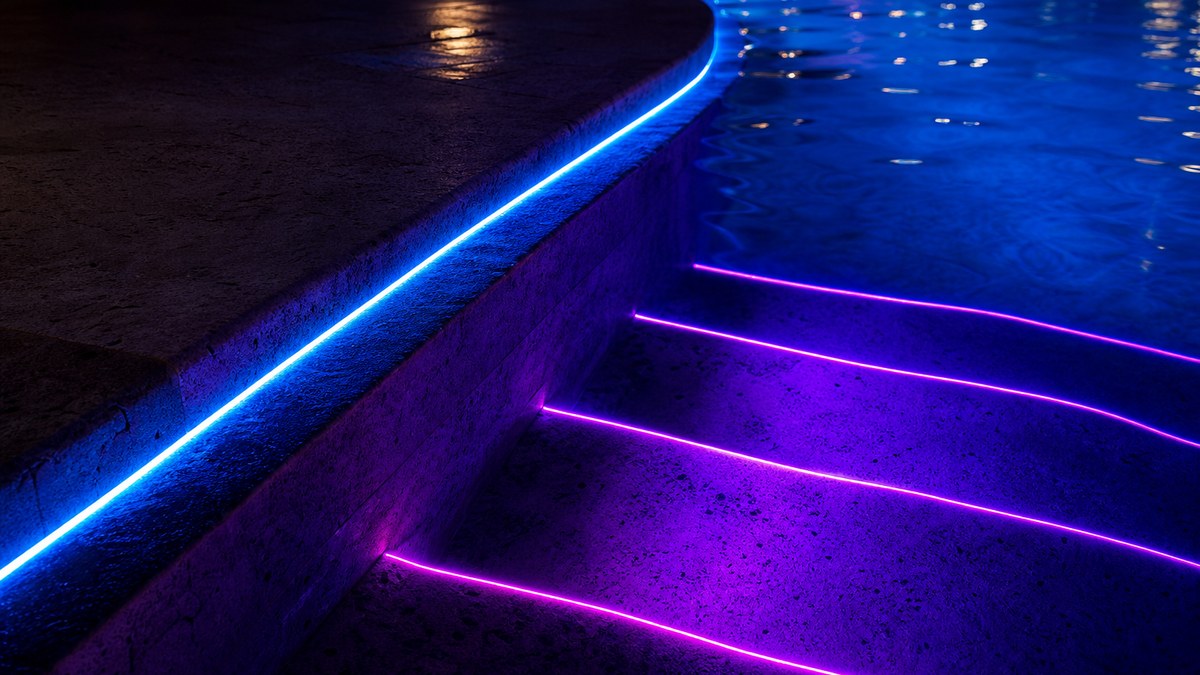
3. Step and bench edges
Lighting each step nose is both a safety feature and a design feature. Swimmers can see every step at night, and from the deck the stairs look like floating bands of color. Add the in-pool bench and you have a lit seating area that guests naturally gather around.
4. Tanning ledge and baja shelf frame
A shallow tanning ledge outlined in light becomes the stage of the pool at night. Frame the ledge edge and, if there are umbrella sleeves or loungers, let the light define that zone in a different color from the main pool.
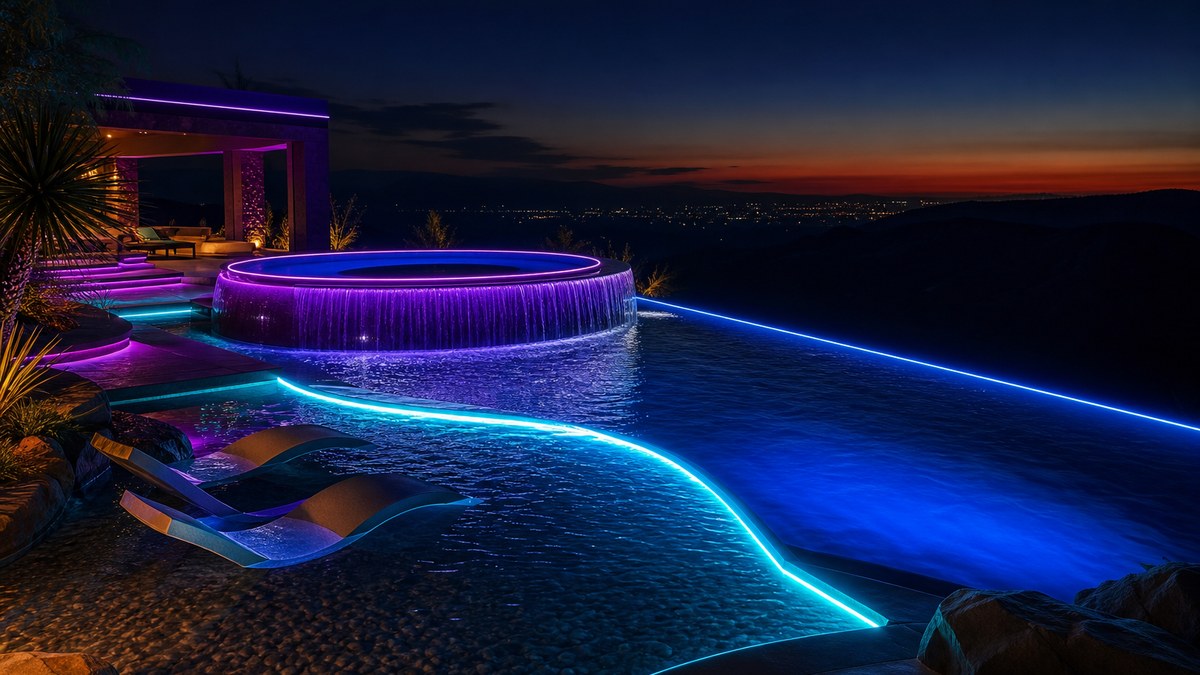
5. Spa ring and spillover
Outline the raised spa, then run the fiber down the spillway edge. When water sheets over a lit lip, the color travels with the water and creates a glowing waterfall into the main pool. This is one of the most photographed details in luxury pool design.
6. Vanishing edge and catch basin
On an infinity or vanishing-edge pool, a line of fiber at the weir edge makes the water appear to end in a ribbon of light. Lighting the catch basin below adds a second layer that is visible from the lower yard. Because there is no electricity in the fiber, it is ideal right where water flows over the edge. See our safest pool lighting guide for why that matters.
7. Beach entry and zero-depth edges
Beach-entry pools have a long, shallow transition where children often play. Outlining that edge shows where the water starts and gives the entry a soft, glowing shoreline effect without placing any fixtures in the play area.
8. Raised bond beam and water wall
A raised wall at the back of the pool is a natural canvas. Run the fiber along the top cap and down the sides of the wall, or along the sheer descent outlets, so the water wall is framed in light. The look is clean and gallery-like.
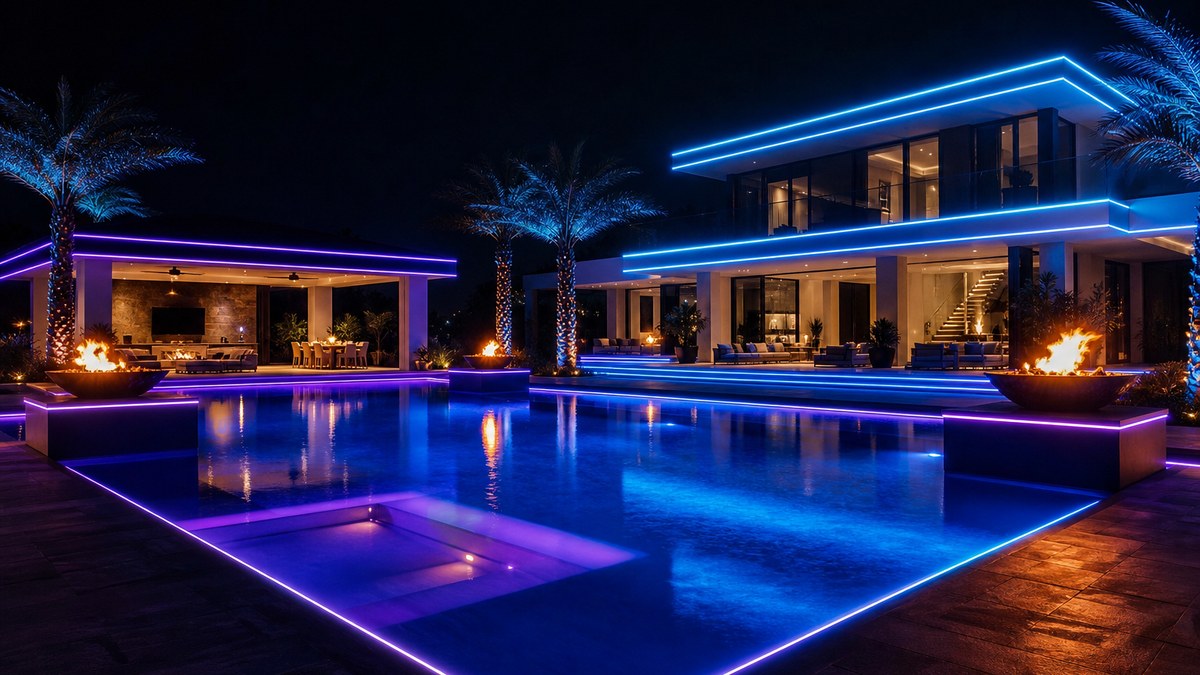
9. Fire bowls and scuppers
Pair cool cyan or violet fiber lines with the warm flame of fire bowls. The contrast between cool light and warm fire is one of the strongest night compositions in outdoor design. Outline the planter or column under each bowl so the features feel connected to the pool edge.
10. Deck border and paver joints
Extend the outline beyond the water. A line along the outside edge of the deck, or between paver bands, frames the entire pool area as one space. It also lights walking paths at night, so guests are not stepping into the dark.
11. Planters, retaining walls and stairs to the pool
Many backyards step down to the pool. Lighting the landscape stairs, retaining wall caps and planter edges leads the eye from the house to the water. The same fiber works on decks, stairs and pergolas, so the whole yard can share one look. For more inspiration, browse our pool lighting ideas collection.
12. Pool house and roofline outline
The boldest version of perimeter lighting does not stop at the pool. Outline the pool house roofline, the cabana, or the rear facade of the home with the same color, and the whole property reads as one design. With a single unit driving 200+ meters of fiber, the Commercial / Architectural system can light the pool and the building lines together. Learn more in our architectural building lighting guide.
Pick one "hero" line (usually the full coping outline) and treat everything else as supporting detail. Too many lines in too many colors can look busy. Two or three colors, used with intention, look the most expensive.
Laser fiber vs LED strip vs traditional fiber for coping lighting
Pool owners often ask whether they can get the same look with an LED strip from a hardware store. Here is how the main pool perimeter lighting options compare.
| Feature | 360° Laser Fiber | LED Strip / Neon Flex | Traditional Fiber |
|---|---|---|---|
| Electricity at the coping | None, the fiber carries only light | Yes, low-voltage circuit next to water | None |
| Look | Smooth, continuous 360° line | Can show dots or hot spots, joints at cuts | Continuous, but often dim |
| Color quality | Very rich and saturated (3x vs LED ribbon) | Good when new | Often washed out at the far end |
| Long runs | 200+ m from one unit | Needs multiple power feeds on long runs | Shorter runs, fades with distance |
| Curves and freeform shapes | Bends, cut to any length | Limited bend radius, cut points only | Bends |
| Heat | No heat at the pool | Some heat at the strip | No heat at the pool |
| Where service happens | Dry, accessible laser unit | At the coping, next to water | Dry illuminator |
| Water and chemicals | 100% waterproof fiber | Depends on sealing; exposed to splash and chlorine | Waterproof fiber |
LED strips are cheaper up front, and they have their place in dry areas like under bar tops or deck rails. At the waterline, though, every LED strip is an electrical product living in a wet, chemical-rich environment. Side-glow fiber was made for that spot. If you are comparing LED fixtures for in-pool light, see our best LED pool lights roundup; many premium pools use LED for general underwater brightness and 360° fiber for the outline.
Why laser makes the difference
Older fiber pool lighting used halogen, metal halide or LED illuminators. The light faded the farther it traveled, so one end of the pool looked bright and the other looked dull. Our patent-pending laser light source concentrates far more light into the fiber, which is how one unit can drive runs of 200+ meters with vivid, even color. The technology won Best New Product at LDI 2024 and was selected by Genesis for the 2026 GV80 campaign. Read how it works on our 360° laser technology page.
Choosing colors and effects for your pool edge
The RGB controller lets you mix colors and set scenes. A few combinations work especially well around water:
- Cyan and electric blue: clean, modern and resort-like. It makes plaster look crystal clear.
- Violet and magenta: dramatic and luxurious, great for entertaining and evening parties.
- Warm white or amber: calm and classic, a good match for natural stone and traditional homes.
- Two-tone zones: one color for the pool, another for the spa or tanning ledge, so each area has its own identity.
- Slow fades: gentle color changes for parties and holidays. Keep the speed slow so it feels elegant, not like a nightclub.
The Commercial / Architectural system adds a DMX-compatible controller, multi-zone capability and custom color programming. That is the right choice when you want the pool, spa, deck and building lines on separate zones, or when a property wants event and holiday scenes. Hotels, HOAs and restaurants can learn more on our commercial lighting services page.
Get a free perimeter lighting layout
Send us your pool plan or photos. We will map the lines, measure the fiber you need and recommend the right system.
How pool coping lighting is installed
New construction
New builds are the easiest and least expensive time to add pool perimeter lighting. The track for the fiber is planned into the coping detail before the stone or concrete is set, and conduit for the fiber runs is laid back to the equipment area with the rest of the plumbing. Your pool builder sets the track, the fiber is pulled and pressed in near the end of the project, and the laser unit is mounted in a dry, ventilated spot near the equipment pad.
Retrofit on an existing pool
You can add perimeter lighting to an existing pool. The fiber can go in a low-profile track mounted under the existing coping lip, or in a channel cut during a coping or tile remodel. A remodel is the ideal moment: if your coping is being replaced anyway, adding the track costs little extra.
Step-by-step overview
- Draw the lines. Mark every edge you want to light: coping, steps, spa, ledges, walls and deck.
- Measure the total length. Add up each run plus the distance back to the laser unit.
- Choose the laser unit location. A dry, ventilated place protected from direct water, often beside the pump and filter.
- Install the track and conduit. Set in the coping during construction, or mounted under the lip in a retrofit.
- Pull, cut and seat the fiber. The fiber is cut to length on site and pressed into the track.
- Power the unit. A licensed electrician connects the laser unit following local code, including NEC Article 680 requirements near pools.
- Program your scenes. Set colors, fades and zones on the controller.
The Residential Starter system comes with a setup guide and video support for confident DIY installers on smaller projects. For full pool perimeters we recommend working with your pool builder, and we provide installation support and consultation. Builders who want a single design-build partner can look at our Luminance program.
Ask your pool builder to include the fiber track and an empty conduit back to the equipment pad in the original bid, even if you plan to buy the lighting later. It costs far less than cutting into finished coping.
How much does pool perimeter lighting cost?
The cost of pool perimeter lighting depends on three things: the total length of fiber, the power of the light source, and how complex the install is. Here is our current 360 Fiber system pricing (early-bird pricing at the time of writing):
Residential Starter
- LF40 4-watt laser unit
- 50 m fiber optic cable
- RGB color controller
- Basic installation kit
- Setup guide & video support
- 1-year warranty
Professional Pool System
- LF40 4-watt weatherproof unit
- 100 m fiber optic cable
- Premium RGB controller
- Pool-specific mounting hardware
- Professional installation kit
- 2-year warranty
Commercial / Architectural
- LF120 12-watt laser unit
- 200 m fiber optic cable
- DMX-compatible controller
- Multi-zone capability
- Custom color programming
- 3-year warranty
Prices cover the system: laser unit, fiber, controller and installation kit. Installation labor by your pool builder or electrician is separate and varies by project. Every order is backed by a 30-day money-back guarantee, and warranty coverage is 1 year on the Residential Starter, 2 years on the Professional Pool System and 3 years on the Commercial / Architectural system. Need something bigger or unusual? Ask us about a custom configuration, and call for current availability.
Sizing your perimeter: which system fits?
- Up to about 50 m of lines: a compact pool, plunge pool or spa outline, or a courtyard water feature. Residential Starter.
- Up to about 100 m: most larger backyard pools with spa, steps and a bench or ledge, or a pool with a double coping line. Professional Pool System.
- Up to 200 m and beyond: resort and lagoon pools, pools plus deck and pool house rooflines, or any project that needs multiple zones and DMX control. Commercial / Architectural.
A quick way to estimate: measure the pool perimeter, add the spa perimeter, add each step and ledge edge, then add the run back to the equipment pad. Send us those numbers and we will confirm the right package. You can compare all three on our systems and pricing section.
Safety and code: why fiber belongs at the waterline
The National Electrical Code has a full article, NEC Article 680, dedicated to swimming pools, spas and fountains, because electricity and water are a dangerous combination. Underwater niche lights and any electrical lighting near the pool must meet strict rules on GFCI protection, bonding and location.
Fiber optic pool perimeter lighting keeps that risk away from the water by design. The fiber is a light guide, not a wire. There is zero electricity in the fiber, no heat at the coping, and nothing electrical at the waterline to fail as seals age. The only electrical part is the laser unit, which sits in a dry location and is powered by a licensed electrician according to local code. That is why fiber is a favorite for families with young children, for HOAs and hotels managing liability, and for splash pads and fountains where people touch the water.
Maintenance: what to expect over the years
Perimeter fiber is low-maintenance. There are no bulbs at the coping to change and no wet niches to reseal, and you never need to drain the pool for a lighting repair. Keep the track clear of debris, keep the laser unit's vents clean and protected from direct water, and that is about it. The materials are 100% recyclable, and the system uses one compact light source instead of many fixtures around the pool.
Frequently Asked Questions
What is the best pool perimeter lighting?
How much does pool perimeter lighting cost?
Can I add perimeter lighting to an existing pool?
Is LED strip safe to use under pool coping?
How much fiber do I need to outline my pool?
Can one system light the pool and the house roofline?
Does fiber optic coping lighting look like dots or a solid line?
Who installs pool perimeter lighting?
What colors can perimeter fiber lighting show?
Is there a warranty or guarantee?
Outline your pool with zero electricity at the water
Choose a system for your pool, or talk to us about a custom configuration for a resort, HOA or commercial property.
Related guides
Want to see more of what 360° fiber can do? Browse all applications, read the product FAQ, or explore the rest of our lighting blog. You can also start on our 360 Fiber Lighting home page.
Explore our lighting network: fiber optic star ceilings, premium pool lighting, Dallas commercial LED lighting, statewide Texas LED lighting, Fort Worth LED lighting, Arlington LED services, Plano LED lighting, Irving LED solutions, wholesale LED solutions, modular building solutions, and modular structures in Dallas.