Fiber Optic vs LED Neon Flex vs LED Strip: Which Outdoor Lighting Is Right for Your Building or Pool?
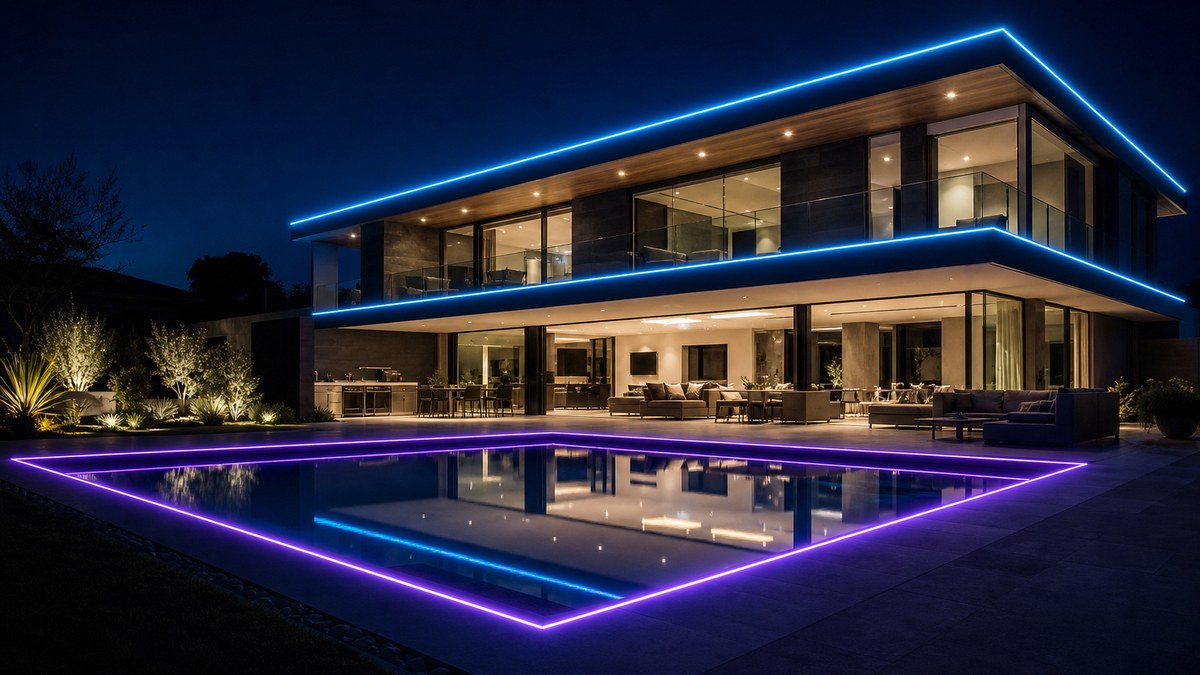
If you are choosing between fiber optic vs LED neon flex or plain LED strip for a roofline, a pool edge or a commercial facade, you are really choosing where the electricity lives. LED strip and LED neon flex put powered circuit boards along every foot of the line. Laser fiber optic keeps all of the power in one remote unit and sends only light down the line. That single difference drives almost everything else: safety near water, how the line looks, how far it can run, and what maintenance looks like years from now.
This guide compares the three most common outdoor "line of light" technologies side by side. We cover how each one works, how they look in real installs, what goes wrong outdoors, what they cost, and when each one is the smart choice. We sell 360° laser fiber optic systems, so we will be clear about where LED is the better buy too. By the end you will know which option fits your pool, home or commercial building, and what a laser fiber system would cost for your project.
For outdoor lines of light, laser fiber optic is the best fit when the line is near water, long, hard to reach or meant to be a signature look. LED neon flex suits signs and short decorative runs on a budget. LED strip is best hidden in coves and channels where you only see the glow, not the source.
- Electricity on the line: fiber has zero; neon flex and strip carry low-voltage power along their full length
- Look: 360° side-glow fiber is a continuous solid line; strip can show dots unless diffused; neon flex is smooth but one-sided
- Run length: one 360 Fiber laser unit drives 200+ m of fiber; LED runs need drivers and power feeds along the way
- Service: fiber is serviced at one dry laser unit; LED failures happen out on the roofline or under the coping
- 360 Fiber system pricing: $7,995, $9,995 and $14,995 (early-bird pricing at the time of writing)
The three technologies in plain English
All three products can produce a glowing line along an edge. They get there in very different ways, and those differences matter more outdoors than anywhere else.
LED strip (LED tape or ribbon)
LED strip is a thin flexible circuit board with small LED chips mounted every few millimeters. It runs on low-voltage DC power (usually 12 V or 24 V) from a driver. Outdoor versions are coated or sleeved in silicone or epoxy to resist moisture. On its own, strip shows a row of bright dots. To make it look like a line, it has to sit in an aluminum channel with a diffuser lens or be hidden in a cove so you only see the reflected glow.
LED neon flex
LED neon flex is LED strip inside a thick, molded diffuser jacket made of PVC or silicone. The jacket spreads the dots into a smooth line that imitates old glass neon. It is popular for signs, logos and decorative lines because it bends and looks smooth at close range. Most neon flex lights from the top or one side only, and it still carries electricity, a driver and connection points along the run.
360° laser fiber optic
Fiber optic lighting separates the light source from the line. A laser illuminator sits in a dry spot, such as an equipment room, a pool pad or a mechanical closet. It sends light into a flexible side-glow fiber that glows along its whole length. Our 360° fiber is designed to glow evenly around its full circumference, so it reads as a solid line of light from any angle. The fiber carries no electricity and no heat, it is 100% waterproof, and it can be cut to any length. Read more about the 360° laser technology.
With LED strip and neon flex, every foot of the line is an electrical product. With fiber optic, every foot of the line is just light. The only electrical part is the laser unit, installed where it is dry and easy to reach.
Fiber optic vs LED neon flex vs LED strip: side-by-side comparison
Here is how the three options compare for outdoor architectural and pool lighting. LED specs vary widely by brand, so the LED columns describe typical products rather than one model.
| Factor | 360° Laser Fiber | LED Neon Flex | LED Strip |
|---|---|---|---|
| Electricity along the line | None | Yes, low-voltage DC | Yes, low-voltage DC |
| Look of the line | Continuous, glows 360° | Smooth, usually one face | Dots unless diffused or hidden |
| Heat on the line | None | Some, from LEDs and drivers | Some, from LEDs and drivers |
| Run from one source | 200+ m from one laser unit | Limited by voltage drop; extra power feeds | Limited by voltage drop; extra power feeds |
| Near pools and water | Ideal: fiber is waterproof and carries no current | Needs proper IP rating and code-compliant install | Needs proper IP rating and code-compliant install |
| Field cutting | Cut to any length | Only at marked cut points | Only at marked cut points |
| Where failures happen | At the dry laser unit | On the line, connectors, drivers | On the line, connectors, drivers |
| Color | Very saturated laser RGB | Good | Good |
| Up-front cost | Higher (system from $7,995) | Low to medium | Lowest |
| Best for | Pools, rooflines, signature facades, long runs | Signs, logos, short decorative lines | Hidden coves, under-cabinet, channels |
The short version: LED wins on up-front price for short runs. Laser fiber wins when the line is long, near water, high on a building or meant to look like one unbroken stroke of light.
How each option looks outdoors
Looks are why most people start shopping, so let's be specific.
The "dot problem" with LED strip
Bare LED strip is a row of bright points. From the street, a roofline lit with exposed strip often looks like a string of beads. Installers solve this with deep aluminum channels and frosted lenses, or by hiding the strip so it washes a surface. Those fixes work, but they add hardware, depth and cost, and the channel itself becomes part of the facade.
Neon flex: smooth, but directional
Neon flex hides the dots well, which is why it took over the sign industry. Most products emit light from the top face or one side. On a building edge seen from several angles, or around a pool you walk all the way around, a one-sided product can look bright from one side and dim from another.
360° fiber: one continuous line
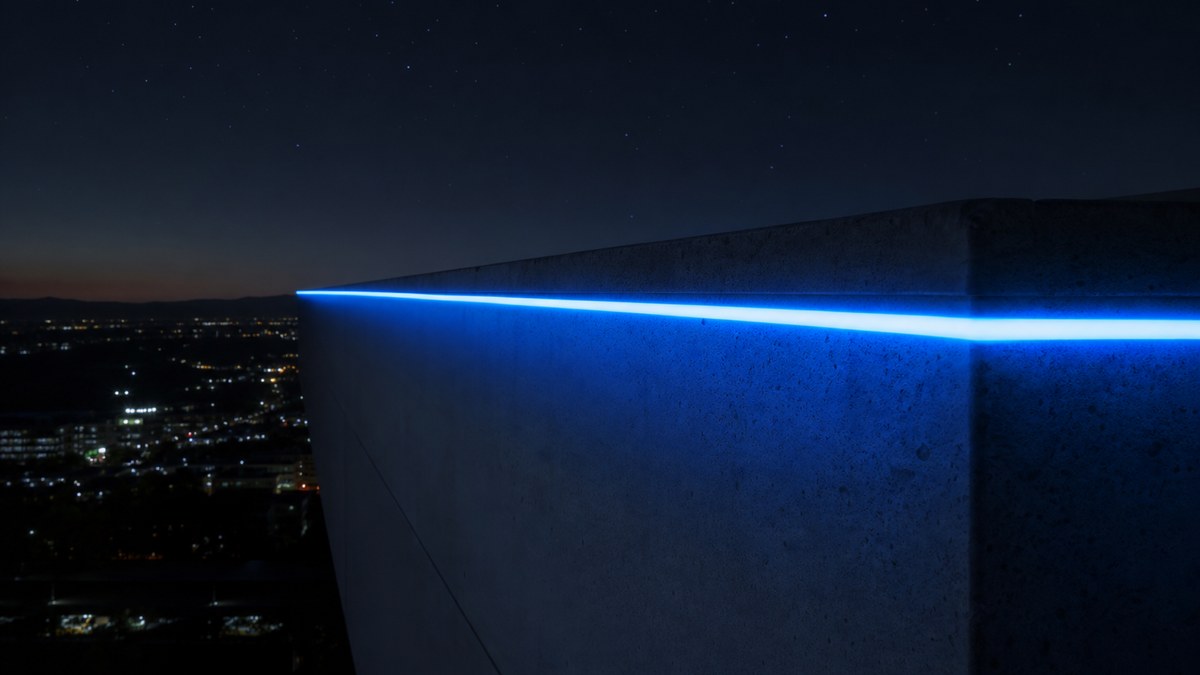
Side-glow fiber has no individual light points at all. The light travels inside the fiber and escapes evenly along its length, so the line looks the same up close and from across the yard. Our 360° fiber glows around its full circumference, and laser light gives it 3x better color saturation than LED ribbon. That is the look you see in our building outline lighting and pool perimeter lighting guides: a crisp, neon-like stroke that traces the architecture.
Safety near water and people: why fiber wins at the pool
Outdoor lighting near pools, spas, fountains and splash pads is governed in the US by the National Electrical Code, Article 680. It sets rules for low-voltage lighting, GFCI protection, bonding and how close power supplies can be to the water. LED strip and neon flex can be installed safely near a pool when the product is rated for it and the install follows code, but the line itself is still electrical, and connectors and splices are the weak points when water gets in.
Fiber optic removes that question from the waterline. The fiber carries light only: no current, no heat, nothing to short out. You can set it right under the coping, along a tanning ledge, inside a water feature or along a vanishing edge. The laser unit still needs power, and a licensed electrician must power the laser unit per local code (NEC 680 near pools), but it lives away from the water in a dry, ventilated location. That is why we call fiber the safest pool lighting option, and why it is the default choice in our fiber optic pool lighting buyer's guide.
The same logic applies on buildings. A roofline lined with LED has power running along the gutter, the parapet or the eaves. A fiber roofline has light running there and power in one place you can lock and reach from the ground.
Durability outdoors: what actually fails
Outdoor lighting lives with sun, rain, sprinklers, pool chemicals, heat and freezing nights. Here is how each technology tends to age.
LED neon flex: watch the jacket material
The diffuser jacket is the part of neon flex you see, so its material matters. Manufacturers themselves point out that PVC jackets are vulnerable to UV and heat: one sign manufacturer's guide describes PVC neon going from slight yellowing in months to deep yellow or brittle within one to two years outdoors, while good silicone jackets resist yellowing far longer. If you choose neon flex outdoors, insist on a UV-stable silicone jacket and an appropriate IP rating such as IP65 or IP67.
LED strip: connectors, drivers and heat
LED strip outdoors usually fails at the joints: end caps, solder points, connectors and power feeds where water can creep in. Drivers mounted near the run add more points of failure, and LEDs themselves produce heat that has to escape from inside a sealed channel. When a section goes dark, someone has to get on a ladder or lift the coping to find it.
Laser fiber: nothing electrical on the line
The fiber has no chips, no solder joints and no drivers, so there is nothing electrical out on the roofline or at the waterline to fail. The fiber is 100% waterproof and gives off no heat. The active part of the system is the laser unit, which sits somewhere dry and accessible. Our system materials are also 100% recyclable. Every system is covered by a warranty of 1 year (Residential Starter), 2 years (Professional Pool System) or 3 years (Commercial / Architectural), plus a 30-day money-back guarantee.
On a two-story roofline, the true cost of any lighting is not just the product. It is every lift rental and service call over the years. Fiber puts the serviceable part on the ground.
Run length and power: one laser unit vs many drivers
Low-voltage LED loses voltage as current travels along the strip. Long runs get dimmer or shift color at the far end unless installers add power injection, thicker feed wire or more drivers along the way. On a big building or a resort pool, that means multiple power points, more wiring and more junction boxes spread across the project.
Laser fiber does not have a voltage drop problem because there is no voltage in the line. A single 360 Fiber laser unit drives 200+ meters of fiber. That is enough to outline a large home's roofline, a big residential pool and spa, or a long commercial facade from one source. Fewer sources mean fewer electrical connections, a simpler install and one control point for colors and scenes.
Quick sizing for outdoor lines
- Up to about 50 m: a spa, a small pool, a courtyard wall or a pergola outline. The Residential Starter (50 m) fits.
- About 50 to 100 m: most larger residential pools with steps and spa, or a one-story roofline. The Professional Pool System (100 m) fits.
- About 100 to 200 m: two-story rooflines, resort pools, restaurant or hotel facades and multi-zone projects. The Commercial / Architectural system (200 m) fits.
Measure every line you want to light, add 10% for corners and routing back to the laser unit, and compare to the system size. Not sure? Send us photos for a free layout review through the quote form.
Get a free lighting consultation
Send us photos, a sketch or plans. We will tell you honestly whether laser fiber or LED fits your project, and how much fiber you need.
Cost: fiber optic vs LED neon flex over the life of the project
LED strip is the cheapest product per foot, and neon flex sits above it. A laser fiber system costs more up front. The honest comparison, though, includes everything you need to make the line look good and keep it working: channels and diffusers for strip, drivers and power feeds for both LED types, electrical work at multiple points, and service access on high or wet lines.
Here is our current 360 Fiber system pricing (early-bird pricing at the time of writing):
Residential Starter
- LF40 4-watt laser unit
- 50 m fiber optic cable
- RGB color controller
- Basic installation kit
- Setup guide & video support
- 1-year warranty
Professional Pool System
- LF40 4-watt weatherproof unit
- 100 m fiber optic cable
- Premium RGB controller
- Pro installation kit
- Pool mounting hardware
- 2-year warranty
Commercial / Architectural
- LF120 12-watt laser unit
- 200 m fiber optic cable
- DMX-compatible controller
- Multi-zone capability
- Custom color programming
- Pro install support, 3-year warranty
System prices cover the laser unit, fiber, controller and installation kit. Installation labor by your contractor, pool builder or electrician is separate and varies by project. Larger or unusual projects can use a custom configuration; call (702) 738-2218 for current availability. Full details are in our systems and pricing section.
When LED is the better value
- A short sign, logo or accent line where looks from one side are fine
- Hidden cove lighting where the source is never seen
- Indoor, dry locations with easy access for service
- Temporary or seasonal displays on a tight budget
When laser fiber is the better value
- Pool coping, steps, spas, water features and vanishing edges
- Two-story rooflines, parapets and facades where service needs a lift
- Long runs that would need many LED power feeds
- Signature brand looks for hotels, resorts, restaurants and casinos that change color with DMX scenes
Best uses for each technology by project type
Residential pools and backyards
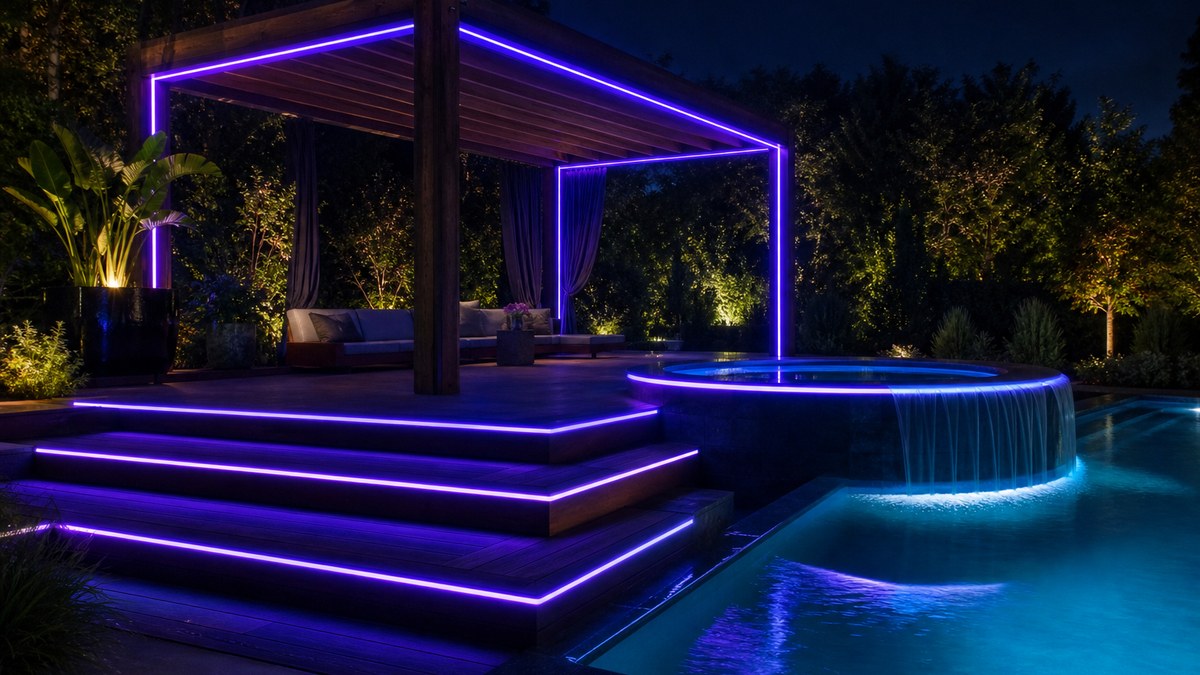
Fiber is the strongest choice anywhere the line touches water or wet decks. Outline the coping, steps and spa with fiber, then extend the same system to deck edges, planters and pergolas. Many owners still use standard in-pool fixtures for general brightness and add fiber for the outline. Our pool perimeter lighting ideas show layout options, and our network partner premium pool lighting specializes in high-end pool lighting projects.
Home rooflines and outdoor buildings
For rooflines, gables, pool houses and cabanas, the deciding factors are height and run length. A fiber roofline gives a crisp continuous outline with the laser unit at ground level. LED neon flex can work on a single story if you choose a UV-stable silicone product and accept service on the roof. See the full process in our building outline lighting guide.
Hotels, resorts, restaurants and casinos
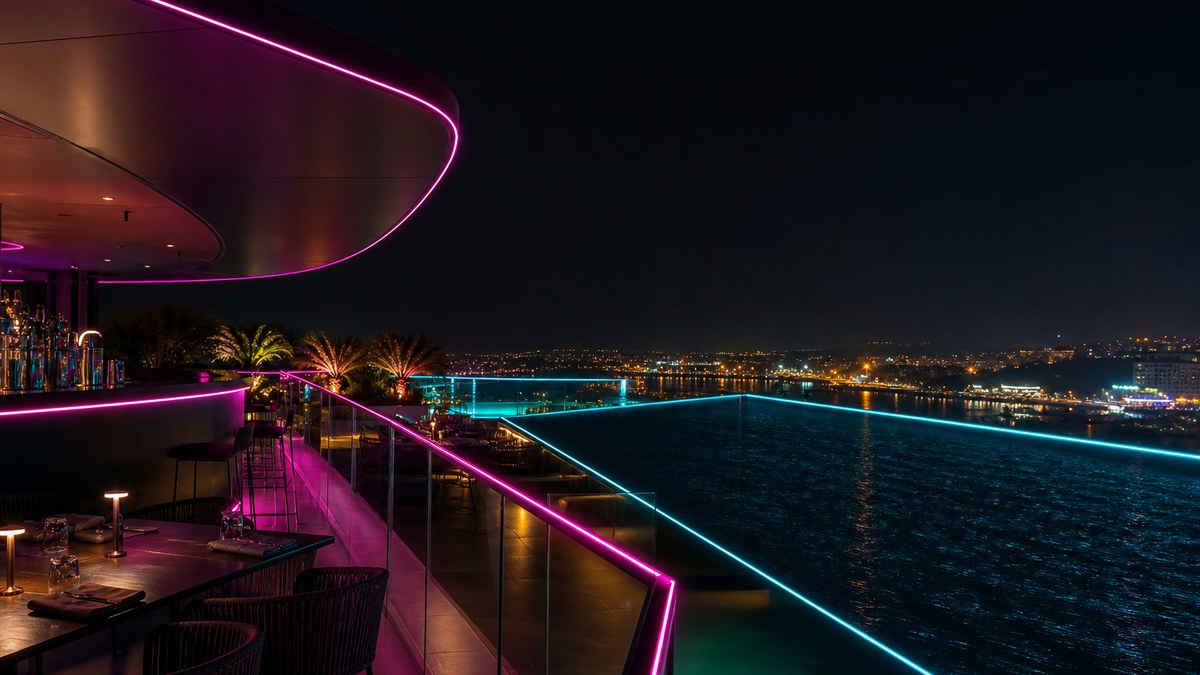
Commercial owners want a signature look, color scenes for events and as few service calls as possible. The Commercial / Architectural system's DMX-compatible controller, multi-zone control and 200 m capacity make it a fit for pools, canopies, columns and facades. Learn more on our commercial lighting services page, our architectural building lighting article, and the Luminance design-build program. Our licensed installation partner has completed 200+ major sports and commercial projects across the US and Canada.
Signs and logos
For lettering and logos, LED neon flex is usually the right tool. It is made for tight bends and short runs, and that is where its price advantage is biggest. For large-format LED signage, our network sites such as Dallas LED lighting and Texas LED lights cover LED options.
Installation differences you should plan for
- Plan the lines. Mark every edge to light and measure total length, including the route back to the power source (LED) or the laser unit (fiber).
- Choose the power location. LED needs drivers and feeds near the runs. Fiber needs one dry, ventilated spot for the laser unit within reach of the fiber routes.
- Mount the track or channel. LED strip goes in channels with diffusers. Neon flex uses mounting clips or tracks. Fiber is pressed into a low-profile track under coping, along eaves or in a parapet reveal.
- Make connections. LED needs sealed electrical connections at each segment and feed. Fiber is cut to length and connected to the laser unit; there are no electrical splices on the line.
- Power and program. A licensed electrician provides power per local code (NEC 680 near pools). Then set colors, fades and scenes on the controller.
Building new or remodeling? Plan the track before the coping, stone or trim goes on. It is far easier than retrofitting later. If you are comparing suppliers as well as technologies, see our checklist in how to choose a fiber optic lighting manufacturer.
Why laser changed the fiber vs LED debate
Older fiber optic systems used halogen, metal halide or LED illuminators. They were safe, but long runs faded and colors looked washed out, which is why LED strip and neon flex took over many outdoor projects. Laser light changed that. It is concentrated enough to drive 200+ meters of fiber from one unit with vivid, saturated color. Our patent-pending laser technology was named LDI 2024 Best New Product and was selected by Genesis for its 2026 GV80 campaign. For the first time, fiber can match LED on brightness and color while keeping its safety and service advantages.
You can see the product range, colors and fiber sizes on our applications section, and get answers to common technical questions in the FAQ.
Frequently Asked Questions
Is fiber optic better than LED neon flex for outdoor lighting?
What is the difference between LED strip and LED neon flex?
Does LED neon flex turn yellow outdoors?
Is fiber optic lighting safe around a swimming pool?
How far can a fiber optic line run compared with LED strip?
How much does a laser fiber optic lighting system cost?
Can fiber optic lighting outline a building roofline?
Can fiber optic lighting change colors like RGB LED?
What warranty comes with a 360 Fiber system?
Upgrade from LED to one continuous line of light
Pick the system that fits your pool, roofline or facade, or ask us about a custom configuration.
Related guides
More guides live on our fiber optic lighting blog, and you can always start at the 360 Fiber Lighting homepage. Explore our lighting network: fiber optic star ceilings, Fort Worth LED lighting, Arlington LED services, Plano LED lighting, Irving LED solutions, wholesale LED solutions, modular building solutions, and modular structures in Dallas.