Hotel & Resort Pool Lighting: Signature Light Lines, DMX Scenes & Less Risk at the Water
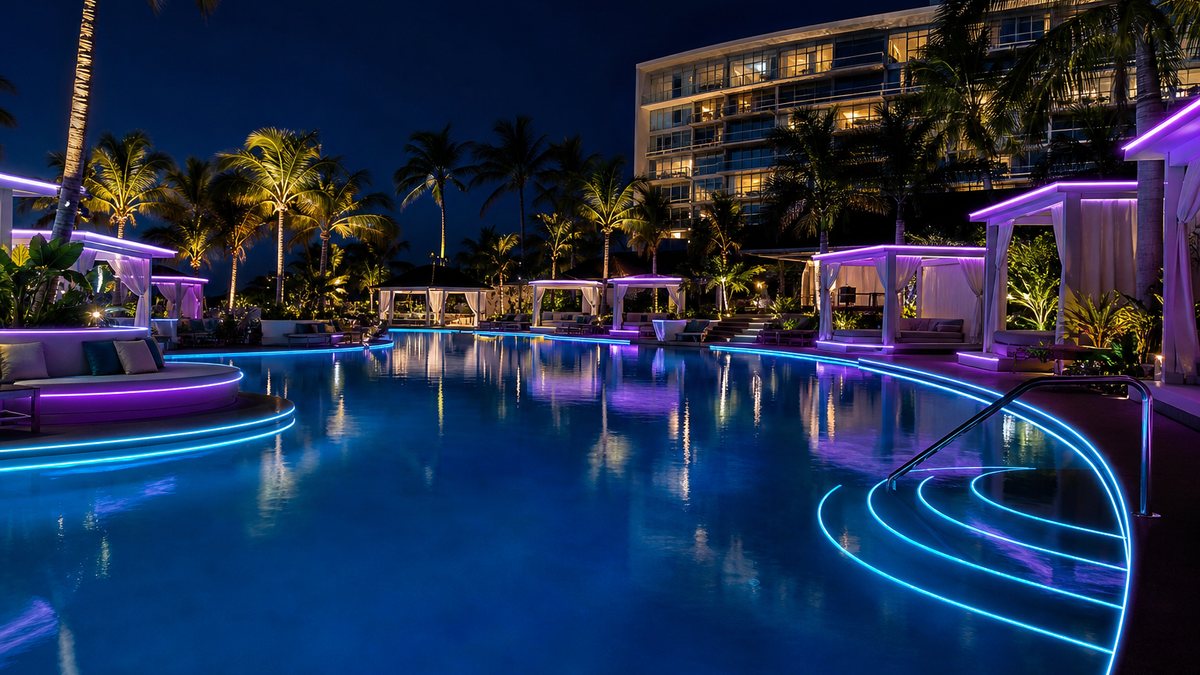
Resort pool lighting does two jobs at once. It has to meet the health and electrical codes that keep swimmers safe after dark, and it has to make the pool the most photographed place on the property. Most hotels solve the first job with underwater fixtures and pole lights, then struggle with the second. That is where laser-powered 360° fiber optic light lines come in.
This guide is written for hotel owners, resort developers, general managers, HOA boards and the architects and pool builders who work for them. It covers how commercial pool lighting is layered, where fiber fits (and where it does not), how DMX color scenes work for events and brand moments, what changes for liability and maintenance when there is no electricity in the light line, and what a commercial system costs. You will also find our real system pricing, so you can budget a signature look before you call anyone.
The best hotel and resort pool lighting uses layers: code-compliant white task lighting for swimmers and lifeguards, plus a signature accent layer that defines the pool's edges, steps, swim-up bar and cabanas. Laser fiber optic lines are ideal for that accent layer.
- Safety: the fiber carries light only, with zero electricity in or near the water; the laser unit sits in a dry equipment room
- Look: continuous 360° lines of color instead of hot spots, visible from guest rooms, rooftops and drone shots
- Control: the Commercial / Architectural system includes a DMX-compatible controller, multi-zone capability and custom color programming
- Scale: 200+ meters of fiber from one LF120 laser unit
- Price: $14,995 for the Commercial / Architectural system (early-bird pricing at the time of writing); installation labor is separate
Why resort pool lighting is a revenue decision
For a hotel, the pool after sunset is not just an amenity. It is the backdrop for weddings, corporate receptions, DJ nights, cabana rentals and the night photos guests post to social media. A pool that goes dark at 8 p.m. or glows a flat, uniform blue from a few wall fixtures does not sell any of that.
A good lighting plan turns the pool into a stage. Lines of light trace the edges and steps, the swim-up bar reads as a glowing island, the cabana row frames the water, and the color can shift from a calm brand color on a Tuesday to a full celebration scene on a Saturday. Guests see it from their balconies, from the lobby bar and from the street. Event planners see it in your sales deck.
That is also why the lighting decision belongs with the commercial team, not only the maintenance team. The goal is a signature look the property can repeat every night for years, with as little downtime and as little risk at the water as possible. Our commercial lighting services page explains how we support hospitality projects from layout to commissioning.
The layers of commercial pool lighting
Lighting designers think about hotel pools in layers. Each layer has a different job, and mixing up the jobs is the most common mistake we see.
Layer 1: Code and safety illumination
Public and semi-public pools, which include hotel, resort, apartment and HOA pools, are regulated by state and local health codes. If a pool is open after dark, the code sets a minimum level of light so lifeguards, staff and other swimmers can see every part of the pool, including the bottom of the deep end. The rules vary by state. For example, Nevada's public pool rule (NAC 444.142) requires lighting designed so that all parts of the pool, including the bottom, can be readily seen without glare, and sets a minimum of 10 lamp lumens per square foot of water surface where underwater lighting is used. Utah's rule (R392-302-18) calls for at least 10 horizontal foot-candles at the water surface for outdoor pools used at night and 30 for indoor pools.
This layer is normally white light from underwater fixtures and area lights, designed by an engineer to hit the numbers your local health department requires.
Layer 2: Wayfinding and edge definition
Guests need to see where the deck ends and the water begins, where the steps are, and where the spa edge drops. Lines of light at the coping, step nosings, benches and tanning ledges solve that. This is where 360° side-glow fiber shines, because it reads as one continuous line rather than a row of dots.
Layer 3: Signature and brand accent
The emotional layer: color, movement and scenes. It is what makes the pool recognizable in photos. Fiber lines on the pool edge, swim-up bar, raised walls, cabanas, fire features and even the building roofline can all be programmed together.
Layer 4: Landscape and architecture
Palms, planters, pergolas and the hotel facade itself. Tying the pool lines to the roofline creates one composition guests see from across the property. Our building outline lighting guide covers that side in detail.
Fiber optic light lines are an accent and wayfinding layer. They do not replace the code-required illumination for night swimming. Your engineer or pool designer should size the safety lighting to your local health code first, then add the signature layer on top. Many operators also switch the pool to white or soft light during open swim hours and save saturated color scenes for after-hours events and views.
Why laser fiber fits hotels and resorts
Fiber optic lighting has been used around pools for decades because it keeps electricity out of the water. The weakness of older systems was brightness and color: halogen, metal halide and early LED illuminators faded over long runs, so the far end of a big pool looked dull. Our patent-pending laser light source changes that. Laser light is far more concentrated, which is why one unit can drive 200+ meters of fiber with 3x better color saturation than LED ribbon. The technology was named Best New Product at LDI 2024 and was selected by Genesis for its 2026 GV80 campaign. You can read more about the 360° laser technology on our home page.
For hospitality properties, that adds up to five practical advantages:
- Zero electricity at the water. The fiber is light-only. All electrical parts live in the laser unit in a dry, ventilated equipment room.
- No heat in the fiber. Guests can touch step and bench lines without any warm surfaces.
- 100% waterproof fiber. It can run at the waterline, through water features and around wet decks.
- Long runs, fewer sources. One LF120 laser unit can light 200+ meters of fiber, so a large pool, spa and bar can be lit from one location.
- Service stays dry. There are no bulbs or electrical parts in the light line, so lighting service happens at the laser unit, not in the pool.
We go deeper into the safety side in our guide to the safest pool lighting, and into the technology choice in fiber optic vs LED neon flex vs LED strip.
Liability, safety and the electrician
Every hotel risk manager asks the same question: what happens when something fails? With conventional underwater fixtures, the electrical connection sits in a wet niche in the pool wall. The National Electrical Code (NEC Article 680) sets detailed rules for those fixtures, including GFCI protection, bonding and where power supplies can go, because electricity and water are a dangerous combination. When seals age or installs are done poorly, the risk rises, and service often means draining the pool or sending a diver.
With fiber, the part that touches the water carries only light. There is nothing in the light line that can energize the water. The laser unit still needs a proper electrical connection, and that connection must be made by a licensed electrician according to local code (NEC 680 near pools and spas). The difference is that the electrical work happens in an equipment room, not in the pool shell.
For properties that run splash pads, beach-entry pools, lazy rivers or children's areas, that difference matters even more. People touch the water, sit on the edges and lean on the walls. Light lines that carry no current and produce no heat are a natural fit there.
Ask your engineer to keep the light-only accent layer separate from the electrical safety lighting on the drawings. It makes inspections, maintenance scheduling and future upgrades simpler, and it documents clearly that the accent lines carry no current at the water.
Laser fiber vs other options for commercial pools
Here is how the main accent-lighting choices compare for a hotel or resort pool. Remember that every option still sits on top of the code-required safety lighting.
| Feature | 360° Laser Fiber | Underwater LED Fixtures | LED Strip / Neon Flex |
|---|---|---|---|
| Electricity at the water | None in the fiber | Yes, in the wet niche | Current runs through the whole strip |
| Look | Continuous 360° line of color | Pools of light from each fixture | Line, often with visible points |
| Color quality | 3x saturation vs LED ribbon | Good | Limited color accuracy |
| Run from one source | 200+ m from one laser unit | One fixture per position | Limited run lengths |
| Heat at the light line | None | Some, at the fixture | Heat build-up |
| Where service happens | Dry laser unit in equipment room | In the pool wall | Along the strip, often outdoors |
| Cutting and shaping | Cut to any length, follows curves | Fixed positions | Specific cut points only |
| Control | DMX-compatible, multi-zone (Commercial) | Varies by brand | Varies by brand |
| Best role | Signature edges, steps, bars, cabanas | Code illumination of the water | Signage and indoor accents |
In practice, most premium resort pools combine underwater white fixtures for code illumination with a fiber accent layer for the signature look. If you are evaluating vendors, our guide to fiber optic lighting manufacturers lists the questions to ask before you sign a purchase order.
Where to run light lines on a resort pool
Pool perimeter and coping
The signature move: one unbroken line tracing a free-form lagoon or a crisp rectangular lap pool. Side-glow fiber sits in a track under the coping lip, so guests see the glow, not the cable. See 12 layouts in our pool perimeter lighting ideas.
Steps, benches and tanning ledges
Lighting every step nosing and bench edge is the most useful thing you can do for guests at night. It shows where the water gets deeper and makes the pool feel like a high-end resort.
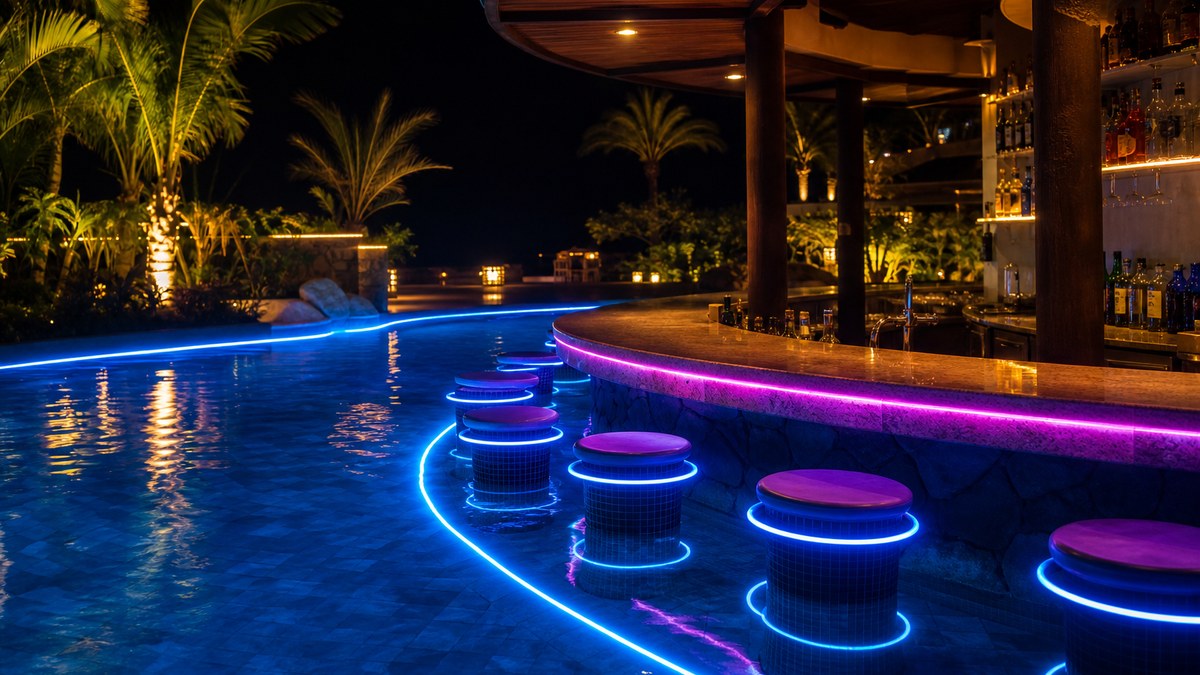
Swim-up bars
Outline the bar counter, the submerged stools and the bar's waterline. Because the fiber carries no current and stays cool, it works right where guests sit and lean.
Spas, spillovers and vanishing edges
Fiber along a spa spillway or vanishing edge adds a glowing waterfall effect. Water features, sheer descents and bubblers can be tied into the same zones. Our network partner premium pool lighting focuses on these specialty pool installs.
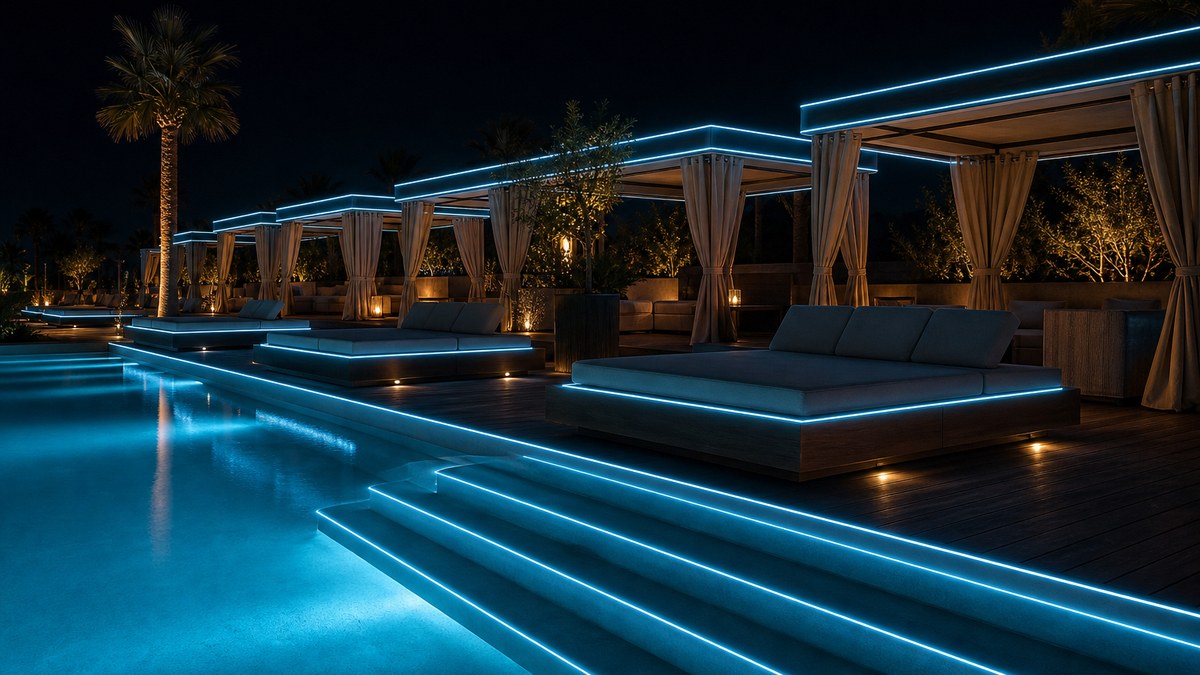
Cabanas, daybeds and fire features
Outlining cabana roofs, daybed platforms and fire-table edges frames the pool and helps sell premium seating. One controller can keep the cabanas, pool and bar in matching colors.
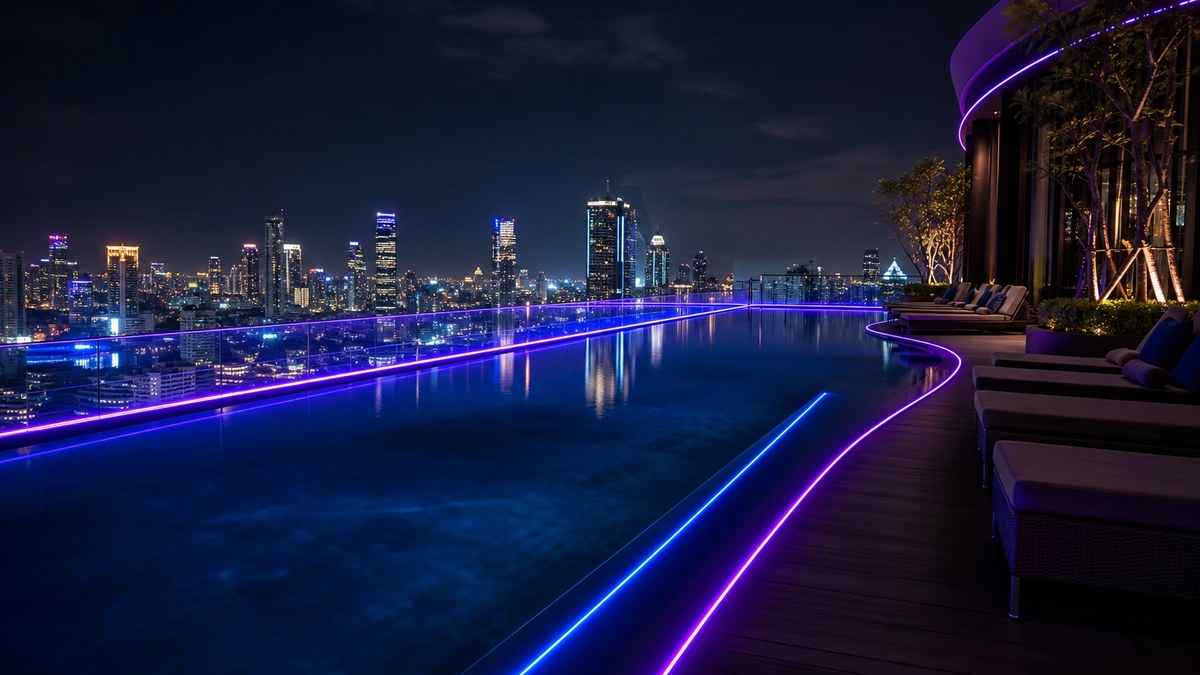
Rooftop pools and the building itself
On a rooftop pool, the parapet and glass edge become the light line. On a resort, extend the same color to rooflines and canopies so the whole property reads as one design from the street. See our architectural building lighting guide.
DMX color scenes for events and brand moments
The Commercial / Architectural system includes a DMX-compatible controller, multi-zone capability and custom color programming. DMX is the control standard used by stage, event and architectural lighting, so the pool lines can be programmed alongside your other show and venue lighting where your controls allow it.
Here is how hotels typically use scenes:
- Daily brand scene: a steady color that matches the property's identity, running every evening.
- Open-swim scene: soft white or low-saturation light on the accent lines while the pool is open, so the white code lighting does its job.
- Event scenes: wedding whites and blush tones, corporate brand colors, holiday palettes, game-day team colors.
- Party scenes: slow fades and color chases for DJ nights and pool parties.
- Zone scenes: cabanas in one color, the bar in another, the pool edge in a third.
Because the scenes are programmed, the team at the front desk or the events office does not need lighting expertise. They pick a scene and the property looks the same every time.
Book a free commercial lighting consultation
Send us your pool plans or photos. We will map the light lines, estimate fiber length and recommend the right system and zones.
How much does resort pool lighting cost?
Commercial pool lighting budgets have two parts: the code-required safety lighting, designed by your engineer and priced by your pool contractor, and the signature accent layer. For the accent layer, cost depends on total fiber length, the number of zones, the control system, and how the track is installed (new construction or renovation).
Here is our current 360 Fiber system pricing (early-bird pricing at the time of writing):
Residential Starter
- LF40 4-watt laser unit
- 50 m fiber optic cable
- RGB color controller
- Basic installation kit
- Setup guide & video support
- 1-year warranty
Professional Pool System
- LF40 4-watt weatherproof unit
- 100 m fiber optic cable
- Premium RGB controller
- Professional installation kit
- Pool mounting hardware
- 2-year warranty
Commercial / Architectural
- LF120 12-watt laser unit
- 200 m fiber optic cable
- DMX-compatible controller
- Multi-zone capability
- Custom color programming
- Professional install support
- 3-year warranty
Prices cover the system: laser unit, fiber, controller and installation kit. Installation labor by your pool contractor and the electrician's connection of the laser unit are separate and vary by project. Every order is backed by a 30-day money-back guarantee. See the full systems and pricing section, or ask about a custom configuration for larger properties.
Sizing a hotel or resort pool
- Boutique hotel pool or rooftop pool: perimeter plus steps often fits within 100 m, so the Professional Pool System may be enough if you only need RGB color without DMX.
- Full resort pool with spa, swim-up bar and cabanas: the Commercial / Architectural system's 200 m of fiber and DMX zones is the usual starting point.
- Lagoon pools, multiple pools or pool plus building outline: a custom configuration with more than one laser unit. Send us your plans and we will lay it out.
Measure every line you want to light, add the step and bench edges, and add a margin for routing back to the equipment room. If you are not sure, the consultation is free.
Installation: new build vs renovation
- Lighting layout. We map the light lines and zones on your pool and site plans and estimate total fiber length.
- Equipment room location. The laser unit goes in a dry, ventilated space within reach of the runs, often the pool equipment room.
- Track installation. In new construction, the pool builder sets the fiber track in the coping, step nosings and bar edges during the build. In a renovation, track goes under replaced coping or in low-profile surface track.
- Fiber pull and seating. Fiber is cut to length on site and pressed into the track.
- Power. A licensed electrician connects the laser unit according to local code, including NEC 680 near pools and spas.
- Programming and handover. Zones, brand colors and event scenes are programmed, and staff are shown how to select them.
For commercial projects we coordinate with your architect, pool builder and electrician. Our licensed installation partner has completed 200+ major sports and commercial projects across the US and Canada, and our team brings 15+ years as an authorized architectural lighting dealer and project coordinator. Properties that want a full design-build service can use our Luminance design-build program.
Plan the fiber track before the coping, step nosings and bar edges are set. It costs far less to include during construction or a scheduled renovation than to add later, and it lets the light line sit hidden under the coping lip.
Maintenance and operations for hotel pools
Hotel engineering teams care about one thing above all: keeping the pool open. Fiber accent lighting is low-maintenance by design. There are no bulbs in the light line, no wet niches to reseal and no reason to drain the pool for an accent-lighting repair. The fiber itself has no electrical parts.
- Keep the laser unit's vents clear and the equipment room dry.
- Keep the fiber track free of debris and pool-chemical residue during routine deck cleaning.
- Review scenes each season so brand and event colors stay current.
- Log the warranty: 3 years on the Commercial / Architectural system, 2 years on the Professional Pool System and 1 year on the Residential Starter.
The fiber is also made from 100% recyclable materials, which helps properties that report on sustainability goals.
Checklist: what to ask before you buy
- Does the lighting plan separate code illumination from the accent layer?
- How many meters of fiber do we need, including steps, benches, bar and cabanas?
- How many zones and scenes do we want, and do we need DMX?
- Where will the laser unit live, and how far is it from each run?
- Who installs the track, and who is the licensed electrician for the laser unit?
- What warranty and money-back terms apply?
- Can the same system extend to the roofline or facade later?
Frequently Asked Questions
What is the best lighting for a hotel or resort pool?
Can fiber optic lighting replace code-required pool lighting?
Is fiber optic lighting safe for commercial pools?
How much does a commercial fiber optic pool lighting system cost?
Can resort pool lighting be controlled with DMX?
How far can one laser unit run fiber around a large pool?
Should a hotel pool use colored light during swimming hours?
Can fiber lighting be added during a hotel pool renovation?
How is fiber optic pool lighting maintained?
Is there a guarantee on commercial systems?
Give your pool a signature look guests remember
Compare systems, or call us about a custom configuration for a hotel, resort, HOA or rooftop pool.
Related guides
Have more questions? Browse the product FAQ, see where the system is used on our applications section, read more on the 360 Fiber Lighting blog or explore fiber at home with a starlight ceiling.
Explore our lighting network: fiber optic star ceilings, luxury pool lighting, Dallas commercial LED lighting, statewide Texas LED lighting, Fort Worth LED lighting, Arlington LED services, Plano LED lighting, Irving LED solutions, wholesale LED solutions, modular building solutions, and modular structures in Dallas.