Pool Lighting Retrofit: How to Add Fiber Optic Lighting to an Existing Pool
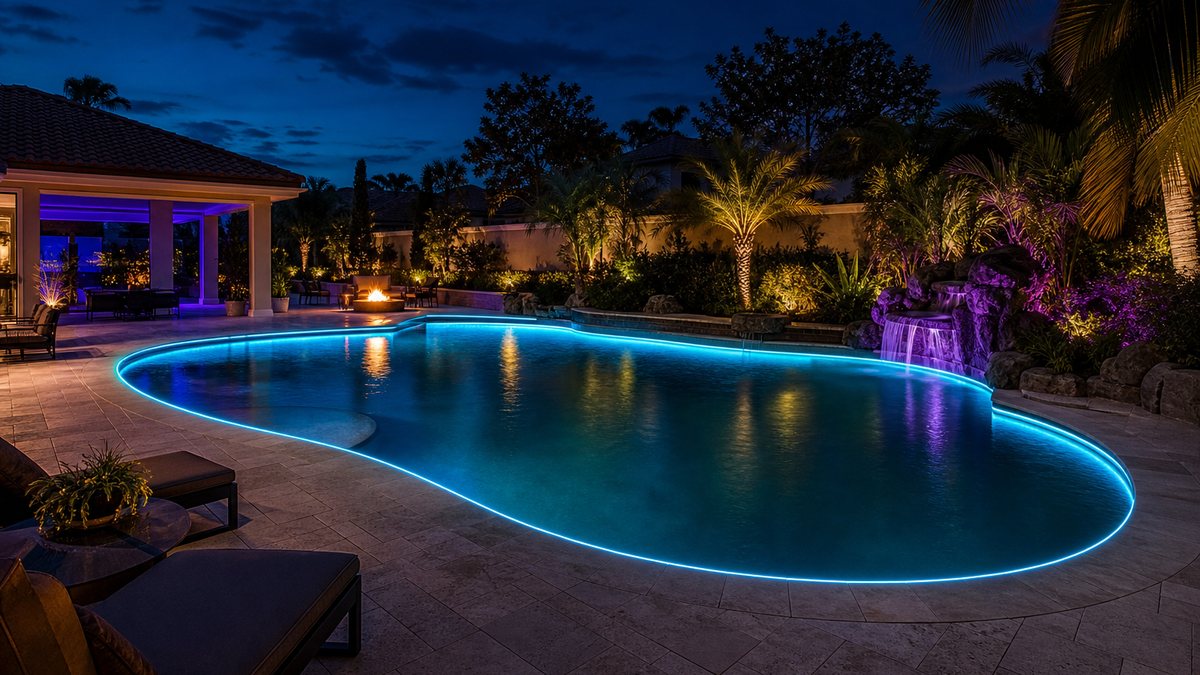
A pool lighting retrofit is the most common way owners upgrade an older pool, and fiber optic is one of the best ways to do it. You do not need a new pool, and in most cases you do not need to drain the one you have. A glowing line of side-glow fiber can be added under the existing coping, along steps and benches, and around the spa, all powered by one laser unit that sits in a dry spot away from the water.
This step-by-step guide covers everything you need to know before you add lighting to an existing pool: which retrofit methods work on which pools, how to measure, where the laser unit goes, what the electrician does, how to sequence the work with a remodel, and what a system costs. We use our real 360 Fiber system pricing so you can plan a budget, and we are honest about where a retrofit is easy and where it takes more work.
Yes, you can add fiber optic lighting to an existing pool. The 360° side-glow fiber is seated in a track under the existing coping lip, in a low-profile surface track, or in a new track set during a coping or tile remodel. A remote laser unit powers the whole run.
- No electricity at the water: the fiber carries only light, so nothing electrical is added to the pool shell
- Usually no new wet niches: unlike adding underwater lights, there is no niche to core into the pool wall
- Best timing: during a coping, tile or deck remodel, when the track can be hidden perfectly
- One unit, long runs: a single laser unit drives 200+ meters of fiber on the Commercial system
- System pricing: $7,995 (50 m), $9,995 (100 m), $14,995 (200 m) at early-bird pricing; installation labor is separate
Why owners retrofit fiber instead of adding underwater lights
When most people think about adding lighting to an existing pool, they picture another underwater light. That usually means coring a new niche into the pool wall, running conduit and a cord back to a junction box, bonding, and following the strict wet-location rules in NEC Article 680. On a gunite or plaster pool it often means draining at least part of the pool and patching the finish. It can be done, but it is invasive, and it puts one more electrical fixture in the water.
A fiber retrofit works the other way around. The light source stays out of the pool entirely. The only thing that goes to the water's edge is fiber, which is glass or polymer carrying light, not current. That is why fiber is often called the safest pool lighting option, and why it is such a good fit for an upgrade: you add a beautiful new layer of light without adding new electrical risk where people swim.
There is also a design reason. Underwater fixtures throw spots of light into the water. 360° side-glow fiber draws a continuous line of color along the edges, which is the look most owners actually want when they browse luxury pool photos. If you already have a working underwater light, keep it for general brightness and add fiber for the outline. The two work well together. Our fiber optic pool lighting buyer's guide explains the difference in detail.
Fiber is an accent and wayfinding layer. On hotel, HOA and public pools it never replaces the night-swimming illumination required by your state health code (for example NV NAC 444.142 or UT R392-302-18). On residential pools, keep any existing underwater light if you want strong in-pool brightness.
Can fiber be added to your pool? A quick checklist
Almost every in-ground pool can take a fiber retrofit in some form. The question is which method gives the cleanest result. Walk around your pool with these questions in mind:
- What is your coping? Natural stone, travertine, brick and poured concrete coping often have an overhang (a lip) above the tile line. A lip gives the fiber a hidden place to sit. Cantilevered concrete decks with a rounded edge can work too. Flush or flat coping with no lip usually calls for a surface track or a remodel.
- What is the pool finish? Plaster, pebble, tile, vinyl liner and fiberglass pools can all be lit from the edge, because the fiber sits at or just above the waterline rather than inside the shell.
- Where is the equipment pad? The laser unit usually lives at or near the pad, a pool house, or a utility room. Note the distance to the nearest edge of the pool.
- Is there an old fiber system? Many pools built in the 1990s and 2000s had halogen or metal halide fiber illuminators that have since failed. Those pools often already have a perimeter channel and conduit routes that your installer can evaluate.
- Are you planning a remodel? If new coping, tile or decking is on the calendar in the next year or two, plan the fiber now so the track can be built in.
If you are not sure what you have, send photos of the coping edge, the steps and the equipment pad. We will tell you which retrofit method fits. You can book a time on our consultation calendar or use the contact form.
Four ways to retrofit fiber optic lighting into an existing pool
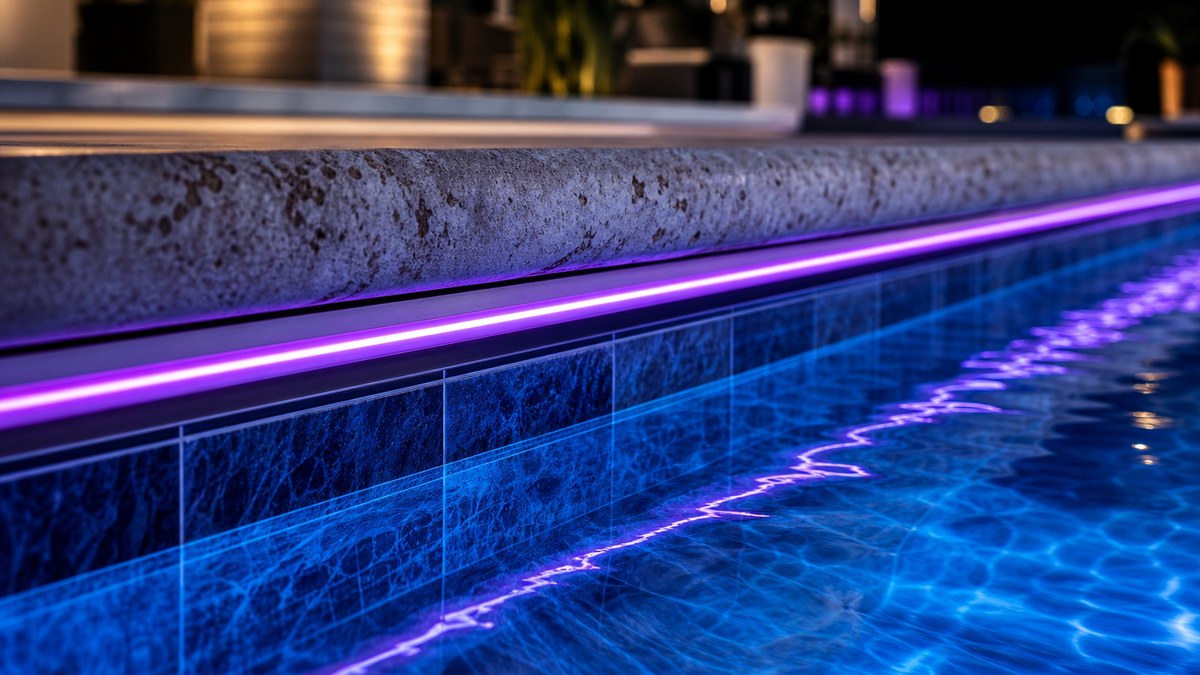
1. Under the existing coping lip
This is the cleanest retrofit when the coping has an overhang. A slim track is fastened to the underside of the coping lip or the top of the tile line, and the fiber is pressed into it. From the deck you see the glow reflecting on the water and tile, not the cable. It keeps the existing coping in place and is the method most owners hope for. For design ideas that use this method, see our pool perimeter lighting ideas.
2. Low-profile surface track
When there is no lip, a low-profile track can run along the face of the coping, the top of the waterline tile, the deck edge, or the riser of each step. The track is visible in daylight, so the color and finish are chosen to blend with the stone or tile. At night it disappears behind the line of light. This is also the usual method for raised spa walls, bench edges and planter walls.
3. Built in during a coping or tile remodel
If the coping or tile is being replaced anyway, this is the best time to add fiber. The track is set into the new coping bed or behind a new bullnose edge, so it is fully hidden and perfectly straight. The extra cost of including fiber during a remodel is far lower than adding it later, and the result looks like it came with the pool. Ask your remodeler to leave the track and a conduit path to the equipment pad before the new coping is set.
4. Re-using an old fiber system's routes
Many older pools already have a dead fiber optic system: a failed illuminator box at the pad, and a perimeter channel or conduits leading to the pool. Some owners convert those systems to LED fixtures. Others want the continuous glow back, only brighter. Where the old channel and conduits are in good condition, an installer can often use them as the path for new 360° fiber, which can make the retrofit simpler. Every old system is different, so this is checked on site.
| Retrofit method | Best for | Look in daylight | Disruption | Drain the pool? |
|---|---|---|---|---|
| Under existing coping lip | Stone, travertine, brick or concrete coping with an overhang | Hidden | Low | Usually no |
| Low-profile surface track | Flush coping, step risers, spa walls, benches | Slim visible track, color-matched | Low | Usually no |
| Built in during remodel | Pools getting new coping, tile or deck | Fully hidden | Part of the remodel | Follows the remodel plan |
| Re-use old fiber routes | Pools with a failed older fiber system | Depends on the existing channel | Low to medium | Usually no |
| New underwater LED niche (for comparison) | Adding general in-pool brightness | Fixture visible in wall | High (core, conduit, patch) | Often yes |
Step by step: a typical fiber retrofit
Every pool is different, but most residential retrofits follow the same sequence. Here is how a well-run project usually goes, from first measurement to the first night the pool glows.
- Photograph and measure. Measure the pool perimeter at the waterline, then add every extra line you want to light: spa, spillway, steps, benches, tanning ledge, raised walls, planters. Note the distance from the pad to the pool.
- Choose the retrofit method for each edge. You might use the coping lip on the pool, surface track on the steps, and a built-in track on the spa if it is being refinished. Mixing methods is normal.
- Pick the laser unit location. A dry, ventilated, shaded spot near the equipment pad, pool house or utility room, protected from direct water and within reach of the runs.
- Plan the fiber path to the pool. The fiber needs a protected route from the unit to the water's edge. Options include existing conduit, a new conduit under or along the deck, or a saw-cut channel that is patched afterward.
- Electrician powers the laser unit. A licensed electrician provides power to the unit following local code, including NEC 680 rules for equipment near pools. Nothing electrical goes to the pool edge.
- Install the track. Track is fastened under the lip, along the surface, or set into the new coping, depending on the method for each edge.
- Cut, pull and seat the fiber. The 360° fiber is cut to length on site and pressed into the track. It bends around curves and free-form shapes.
- Connect and program. The fiber is connected to the laser unit and the controller is set up with your favorite colors, fades and scenes.
Do the pool edge first and plan the extras at the same time. Adding the spa, steps or a pergola later is easy if the laser unit and fiber path were sized for them from the start.
Send us photos for a free retrofit plan
Share your coping edge, steps and equipment pad. We will recommend a retrofit method, fiber length and system size.
How much fiber does an existing pool need?
Fiber is sized in meters, and the system you choose is mostly about total length plus the number of zones you want. A quick way to estimate:
- Pool perimeter: a rectangle is 2 × (length + width). A 16 × 32 ft pool has a 96 ft perimeter, roughly 29 meters.
- Spa: add its perimeter, plus the spillway edge if it has one.
- Steps and benches: add the width of every step edge and bench you want outlined.
- Extras: raised walls, planters, deck edges, pergola beams or a pool house roofline.
- Slack: add a margin for corners, the path to the laser unit and trimming.
As a rough guide, a typical backyard pool plus spa often falls in the 30–60 meter range once steps are included. That fits the Residential Starter (50 m) or Professional Pool System (100 m). Large free-form pools, lagoon pools and projects that also outline the house or cabanas point toward the Commercial / Architectural system with 200 meters and multi-zone control.
What a pool lighting retrofit costs
A fiber retrofit has two parts: the system and the labor. The system price is fixed by package. The labor depends on your retrofit method, the distance from the pad, whether a deck channel or new conduit is needed, and whether the work is folded into a remodel. Here is our current 360 Fiber system pricing (early-bird pricing at the time of writing):
Residential Starter
- LF40 4-watt laser unit
- 50 m fiber optic cable
- RGB color controller
- Basic installation kit
- Setup guide & video support
- 1-year warranty
Professional Pool System
- LF40 4-watt weatherproof unit
- 100 m fiber optic cable
- Premium RGB controller
- Pro installation kit
- Pool-specific mounting hardware
- 2-year warranty
Commercial / Architectural
- LF120 12-watt laser unit
- 200 m fiber optic cable
- DMX-compatible controller
- Multi-zone capability
- Custom color programming
- Pro install support, 3-year warranty
Prices cover the system: laser unit, fiber, controller and installation kit. Installation labor by your pool builder, remodeler or electrician is separate and varies by project. Every order is backed by a 30-day money-back guarantee. See the full details in our systems and pricing section, or ask about a custom configuration if your pool needs more fiber or more zones. Call (702) 738-2218 for current availability.
What makes a retrofit cost more or less
- Lower cost: coping with a usable lip, a short path from the pad, existing conduit, or doing it during a planned remodel.
- Higher cost: no lip and lots of surface track, a long distance from the pad, cutting and patching a deck for a new channel, or many separate zones.
- Avoided cost: no new wet niches, no coring the pool wall, and no underwater fixtures to service later.
Which system fits which existing pool?
| Your existing pool | Typical fiber need | Suggested system |
|---|---|---|
| Compact pool, plunge pool or spa only | Up to about 50 m | Residential Starter ($7,995) |
| Standard backyard pool + spa + steps | About 30–100 m | Professional Pool System ($9,995) |
| Large free-form or lagoon pool, plus deck or pergola | 100–200 m | Commercial / Architectural ($14,995) |
| Pool plus house roofline or pool house outline | 150–200+ m, several zones | Commercial / Architectural or custom |
| Hotel, HOA or community pool | Varies; multi-zone, DMX | Commercial / Architectural or custom |
The Professional Pool System is the most popular choice for retrofits because it adds weatherproof hardware and pool mounting hardware, and 100 meters covers most residential pools with their spa and steps. If you want the same light line to continue onto the home, see our guide to building outline lighting.
Safety and the electrician's role in a retrofit
Adding lighting to an existing pool is one of the places where fiber's safety advantage matters most. Older pools can have aging bonding, older wet-niche fixtures and junction boxes that were installed under earlier code editions. A fiber retrofit does not add anything electrical to that picture at the water. The fiber has zero electricity, produces no heat at the pool, and the fiber itself is 100% waterproof.
The laser unit is still an electrical device, so a licensed electrician should provide power to it following local code and NEC 680 requirements for equipment near pools. That is a simple, dry-side job compared with wiring a new underwater fixture. If your electrician finds issues with existing pool wiring while on site, fix those first; a retrofit is a good moment for a safety check.
Because the laser unit is the only powered part, any service happens at a dry, reachable box at the pad. There are no bulbs in the pool, no niches to reseal and no reason to drain the pool for lighting repairs.
Retrofit design ideas that add the most impact
Outline the waterline first
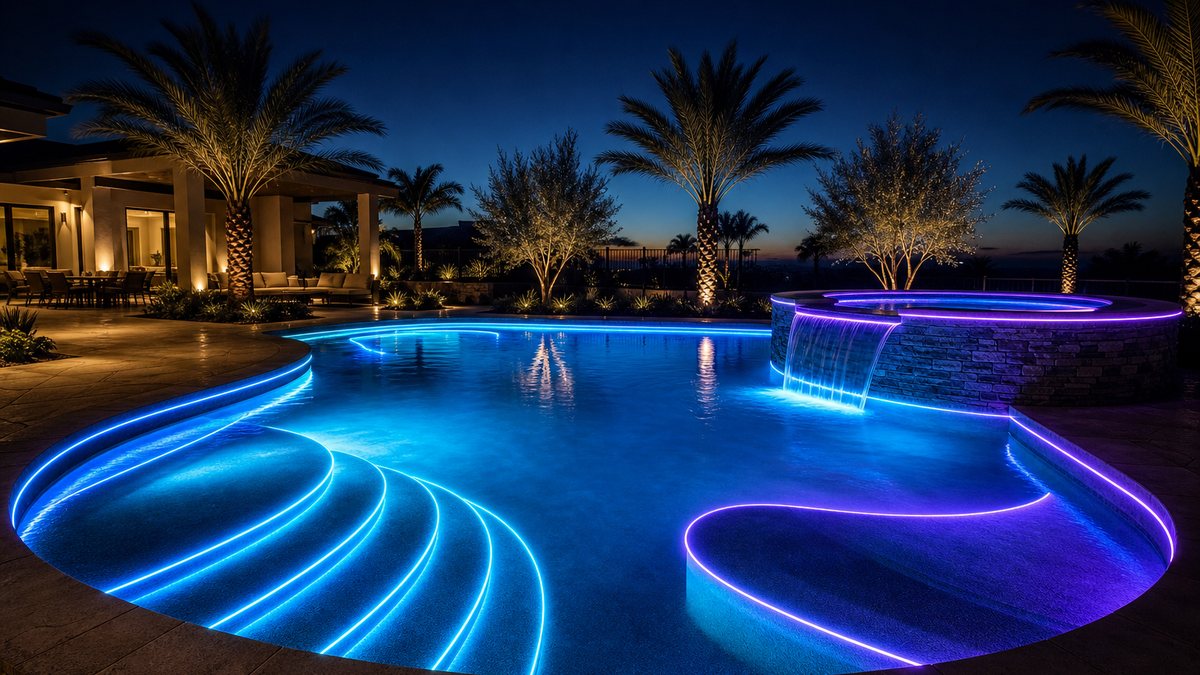
The perimeter line does most of the work. It defines the shape of the pool at night and makes an older pool look newly built.
Light every step and bench edge
Step and bench lines are one of the most useful retrofits for families, because they show exactly where the edges are after dark. They also give the pool a resort feel.
Make the spa and spillway glow
A lit spa rim and spillway turns an ordinary spa into a focal point. Fiber is safe right where water flows, which is why it works so well on water features. See more in our water feature lighting guide.
Carry the line onto the deck, pergola and house
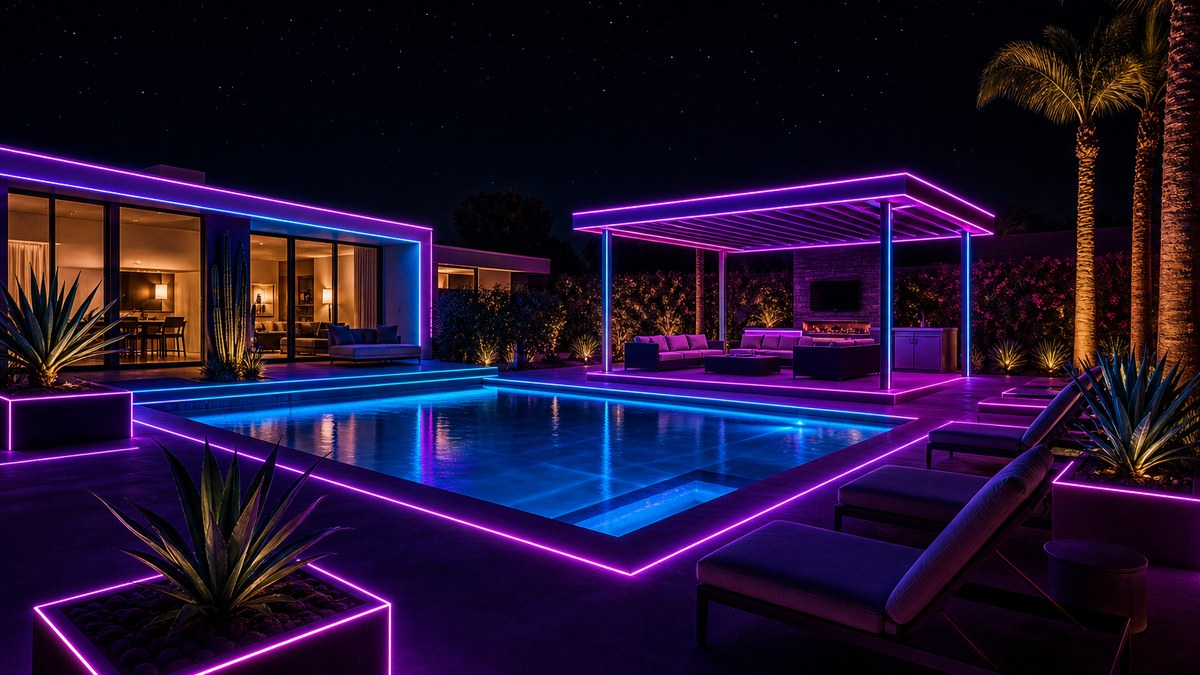
Once the laser unit is in, you can extend the look beyond the water: deck edges, planters, a pergola or cabana, and even the roofline. For how laser fiber compares with other outdoor options, read fiber optic vs LED neon flex.
Why laser-powered fiber is worth it for an older pool
If your pool once had a fiber system, you may remember it as dim. Older illuminators used halogen or metal halide lamps, and the light faded along longer runs. Our 360° system uses a patent-pending laser light source, which is why it delivers 3x better color saturation than LED ribbon and can drive 200+ meters of fiber from one unit. The technology won Best New Product at LDI 2024 and was selected by Genesis for its 2026 GV80 campaign. Learn more about the 360° laser technology and see real applications.
The fiber can be cut to any length on site, bends around curves and free-form shapes, and is made from 100% recyclable materials. For an existing pool, that flexibility is exactly what you need, because no two older pools have the same edges.
Commercial pools: retrofitting hotels, HOAs and resorts
Hotels, resorts, HOAs and clubs retrofit fiber for the same reasons homeowners do, plus a few more: a signature brand color, DMX scenes for events, and less to service in the water. The Commercial / Architectural system adds DMX control, multi-zone capability and custom color programming. Remember that on public and commercial pools, fiber is an accent and wayfinding layer and never replaces code-required night-swimming illumination. Our hotel and resort pool lighting guide covers the commercial side in detail, and our commercial lighting services and Luminance design-build program support larger projects. Our licensed installation partner has completed 200+ major sports and commercial projects across the US and Canada.
Frequently Asked Questions
Can you add fiber optic lighting to an existing pool?
Do I have to drain my pool to retrofit fiber optic lighting?
How much does it cost to retrofit fiber optic pool lighting?
Is retrofit fiber lighting safe in an older pool?
What if my pool coping has no overhang?
Can I replace an old, dead fiber optic pool light system?
Should I keep my existing underwater pool light?
How much fiber does an existing pool need?
Can I install a retrofit system myself?
What warranty and guarantee come with the system?
Give your existing pool a brand-new glow
Pick the system that fits your pool, or call us for a custom retrofit configuration.
Related guides
Explore our lighting network: premium pool lighting, fiber optic star ceilings, Dallas commercial LED lighting, statewide Texas LED lighting, Fort Worth LED lighting, Arlington LED services, Plano LED lighting, Irving LED solutions, wholesale LED solutions, modular building solutions, and modular structures in Dallas. More guides on the 360 Fiber Lighting blog and answers in our FAQ.