Water Feature Lighting: Fiber Optic Ideas for Fountains, Splash Pads & Vanishing Edges
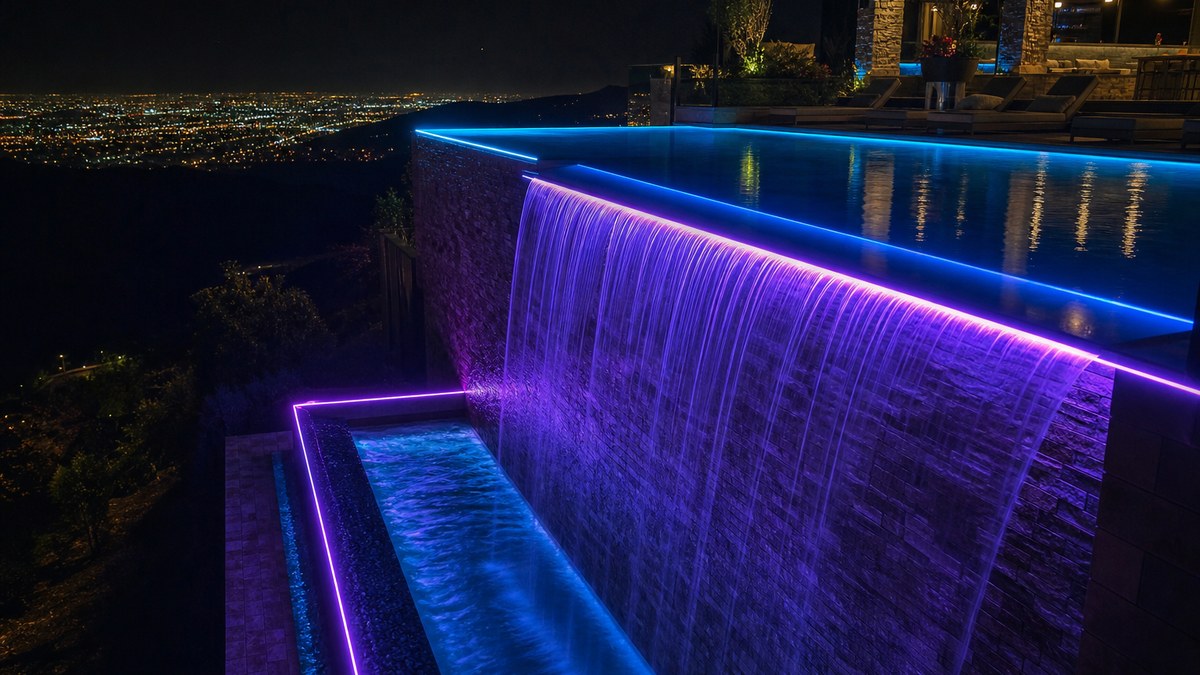
Water feature lighting is where a good backyard or resort becomes unforgettable. Fountains, sheer descents, spillways, bubblers, water walls and vanishing edges are built to be watched, and after dark they only exist if you light them. The challenge is that these are the wettest, splashiest places on the property, and the places where people reach in, wade through or stand right at the edge.
That is exactly why laser-powered 360° fiber optic lighting fits water features so well. The fiber carries light, not electricity, so the glowing line can run right where water moves while every electrical part stays in a dry laser unit somewhere else. This guide covers water feature lighting ideas for fountains, splash pads, sheer descents and vanishing edges, how fiber compares with LED fixtures, how to plan the runs, what a system costs, and the safety and code points every owner, pool builder and property manager should know.
The best water feature lighting puts a continuous line of light where water starts, falls or overflows, and keeps electricity away from the water. Side-glow fiber optic lighting does both.
- Where to light: the lip of sheer descents and spillways, the rim of fountain basins, the edge of a vanishing-edge catch basin, splash pad borders and the steps or paths around them
- Why fiber: zero electricity in the fiber, 100% waterproof fiber, no heat, cut to any length and bends around curves
- How much line: one laser unit drives 200+ meters of fiber, so a pool, spa and several features can share one source
- Cost: 360 Fiber systems are $7,995 (50 m), $9,995 (100 m) and $14,995 (200 m, DMX, multi-zone) at early-bird pricing; installation labor is separate
- Code: a licensed electrician powers the laser unit per local code (NEC Article 680 covers pools and fountains), and fiber never replaces code-required lighting at public pools or splash pads
Why water features are the hardest place to light well
A pool wall stays still. A water feature does not. Light has to cope with moving water, constant splash, mineral deposits, freeze and thaw, sun on the basin all day, and people touching the water. Traditional answers each come with a compromise:
- Underwater spot fixtures make bright pools of light under a fountain jet, but they are electrical devices in the water. They need wet niches or listed submersible housings, GFCI protection, bonding and periodic service where the water is.
- LED strip under the lip gives a line of light, but the whole strip is a powered circuit sitting in the wettest spot on site. Encapsulation can yellow or crack outdoors, and long runs need multiple feeds.
- Old fiber systems kept power away from the water but often looked dim and faded along the run, especially in daylight-to-dusk transitions when people first notice a feature.
Laser-powered side-glow fiber removes the main trade-off. The light source is concentrated enough to keep long lines bright and saturated, and the part that sits in the spray is glass-clear fiber with nothing electrical inside. If you are new to the technology, our 360° laser technology overview explains how one remote unit lights the whole length of the fiber.
Light the edge where water changes: where it starts to fall, where it overflows, where it lands. A thin continuous line at those edges reads as "the water is glowing", which is the look owners and guests remember.
12 water feature lighting ideas with fiber optics
These are the placements we are asked about most often for residential pools, resorts, restaurants and commercial plazas. Most projects combine three or four of them on one laser unit.
1. Sheer descent and rain curtain lips
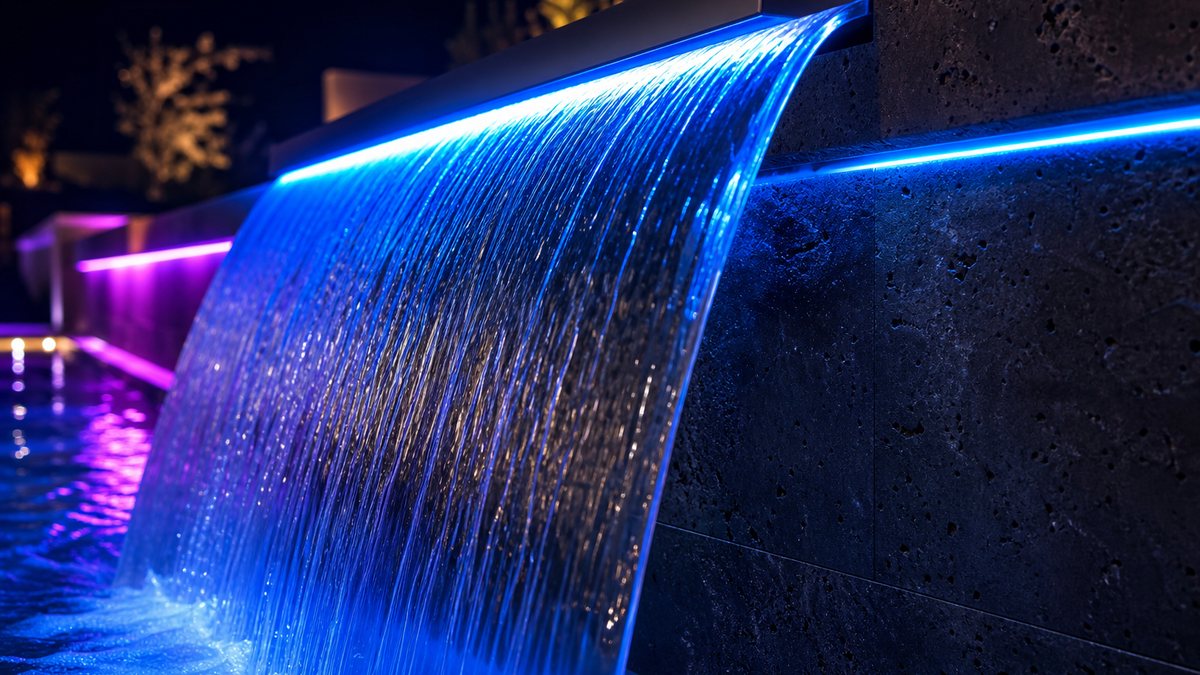
Run fiber in a track directly under the lip of a sheer descent so the falling sheet of water catches the light as it leaves the edge. The water acts like a lens, so even a thin line looks like the whole sheet is lit. This is the single most dramatic place to put fiber on a pool.
2. Spa spillways into the pool
Outline the spa coping and the spillway edge in one color, then let the pool perimeter carry a second color or a slow fade. Owners often match the spa line to the house roofline so the whole yard reads as one design. See more coping placements in our pool perimeter lighting ideas.
3. Vanishing edge and catch basin
On a vanishing-edge (infinity) pool, light the knife edge itself and the lip of the catch basin below. From the house you see a glowing horizon line; from the lower terrace you see the water sheet lit from above and below. Because there is no current in the fiber, the line can sit right at the waterline where splash is constant.
4. Fountain basin rims
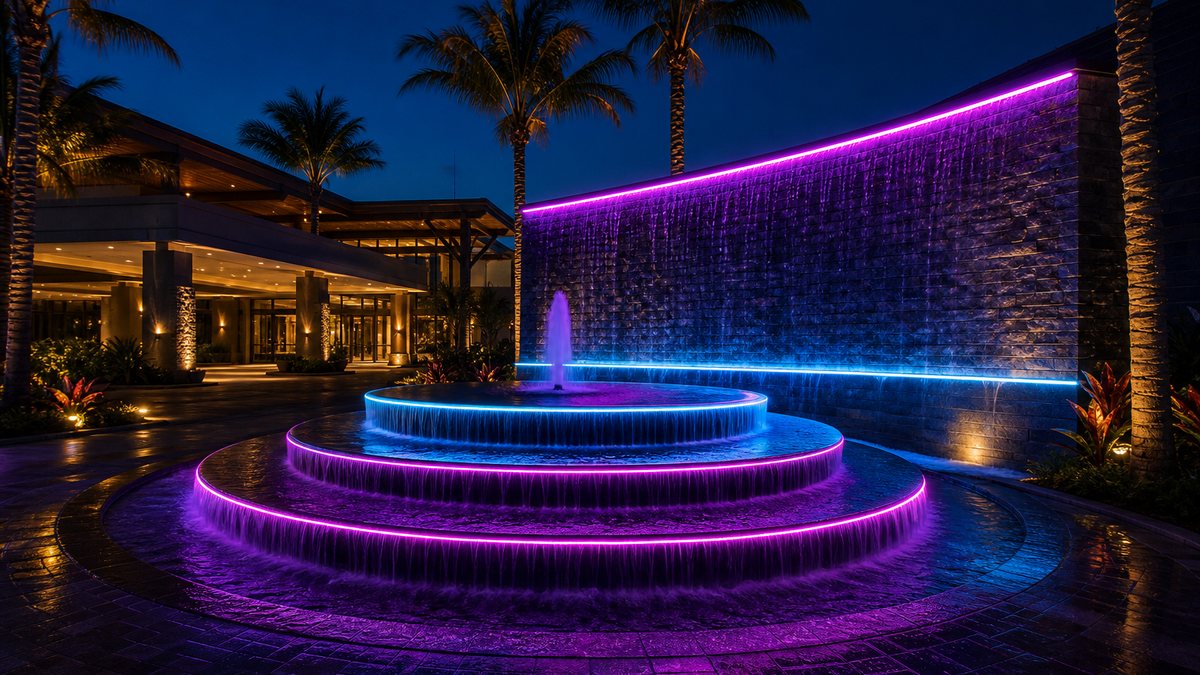
Trace the top rim of a round or rectangular fountain basin with side-glow fiber. Paired with the sound of the water, a steady ring of soft white or blue turns a courtyard or hotel entry fountain into a landmark after dark.
5. Tiered and bowl fountains
Stacked bowls, tiered basins and scupper bowls can each get a line under the lip so every tier glows. Cut-to-length fiber makes it easy to give each bowl its own run from the same unit.
6. Water walls and scuppers
A horizontal line at the top of a water wall, or a short run under each scupper, lights the falling water without putting fixtures in the trough. On commercial facades this pairs naturally with building outline lighting on the parapet above.
7. Bubblers on tanning ledges
Outline the tanning ledge and let bubblers break the surface inside the lit border. For true point-of-light accents, end-glow fiber tips can be used in the ledge floor, the same principle as a starlight ceiling.
8. Splash pad borders and paths
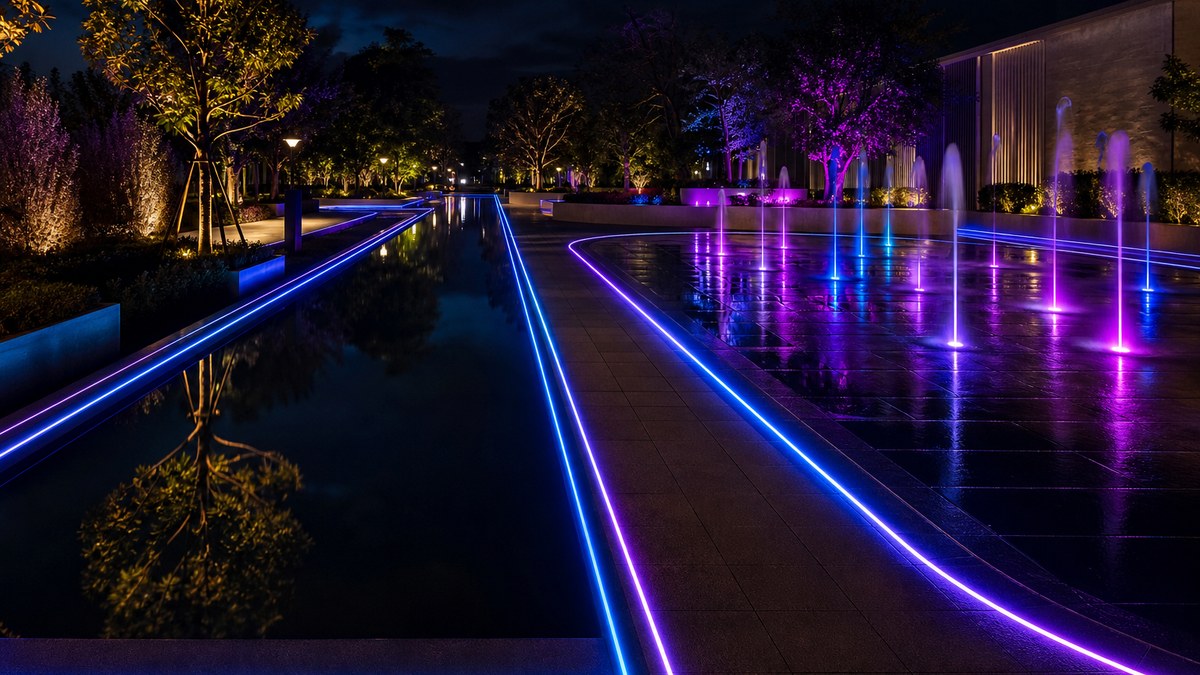
Use fiber to define the edge of a splash pad, the drain line and the walkway in, so people can see where the wet zone begins at dusk. This is wayfinding and atmosphere, not a replacement for the general illumination a public splash pad needs (more on that below).
9. Reflecting pools and runnels
Long, narrow reflecting pools and garden runnels are perfect for continuous fiber because one unbroken line can run 30, 50 or 100 meters. The still water doubles the line in its reflection.
10. Koi ponds and natural edges
Fiber produces no heat at the line and carries no current, which makes it a gentle choice along pond edges and stone shelves. Keep colors soft at night and plan the run so the fiber can be accessed for cleaning.
11. Swim-up bars and lagoon features
For resorts, outline the swim-up bar counter, the lagoon island and the waterfalls behind it, then program DMX scenes for events. Our guide to hotel and resort pool lighting covers how to layer this on commercial pools.
12. The architecture behind the water
Many of the best water features sit against a wall, pergola or cabana. Carry the same fiber line up the structure so the feature and the building read as one composition. The architectural building lighting guide shows how that works on larger buildings.
Fiber optic vs LED for water feature lighting
Every option has a place. Here is how they compare specifically for fountains, spillways and vanishing edges, where water is moving and people are close.
| Factor | 360° Laser Fiber | Underwater LED Fixtures | LED Strip / Neon Flex |
|---|---|---|---|
| Electricity at the water | None in the fiber | Yes, in the fixture | Yes, along the whole strip |
| Look on falling water | Continuous glowing line, water sheet lit | Spots and hot points under jets | Line, often with visible dots |
| Color | 3x saturation vs LED ribbon | Good | Varies; can shift as encapsulation ages |
| Heat at the feature | None in the fiber | Some at the fixture | Some along the strip |
| One source covers | 200+ m of line | One spot per fixture | Limited runs per feed |
| Where service happens | Dry laser unit away from water | In the water feature | At the water line |
| Curves and odd shapes | Bends, cut to any length | Fixed positions | Specific cut points |
| Best use | Edges, lips, rims, outlines | Lighting a jet or plume from below | Dry architectural accents |
For a deeper comparison of line-style options, read fiber optic vs LED neon flex vs LED strip. Many premium projects use both: fiber for every edge and outline, and listed underwater fixtures where a jet or plume needs light from below.
Safety and code: what owners need to know
Water features get less attention than pools in safety conversations, but they are often more hands-on. Children put their hands in fountains, guests wade into splash pads, and staff reach into basins to clear debris. The National Electrical Code treats permanently installed fountains under Article 680 (the same article that covers pools and spas), with rules for GFCI protection, bonding, grounding and how submersible equipment is installed and serviced.
Fiber optic lighting does not remove the need for a proper electrical installation. It moves it. The laser unit is the only electrical part, and it sits in a dry, ventilated equipment area. A licensed electrician should power the laser unit according to local code, including NEC 680 requirements near pools, spas and fountains. What changes is that the glowing line itself, the part people see and touch, carries no current. Our guide to the safest pool lighting explains this in more detail.
For hotel, HOA and public pools and splash pads, fiber is an accent and wayfinding layer. It never replaces the night-swimming or general illumination that state health codes require (for example Nevada NAC 444.142 or Utah R392-302-18). Plan the code-required light first, then add fiber lines for the edges, features and atmosphere.
Practical safety checklist
- Keep the laser unit out of splash zones, flood paths and direct water, with clear ventilation
- Route fiber in a track so it is protected from foot traffic, pool equipment and cleaning tools
- Have a licensed electrician supply power to the unit and confirm local inspection requirements
- On public or commercial sites, confirm required light levels with the health department before design
- Plan access so the track can be cleaned of scale and debris
Get a free water feature lighting consultation
Send photos or plans and the lines you want to light. We will map the runs, the laser unit location and the right system.
How to plan water feature lighting: step by step
- List every edge you want to see at night. Spillway lips, fountain rims, the vanishing edge, catch basin, splash pad border, steps and paths. Mark them on a plan or a photo.
- Measure each run in meters. Add the distance from each feature back to the laser unit location. A typical backyard spa spillway plus a sheer descent can be 10–25 meters; a vanishing edge plus catch basin on a large pool can be 30–60 meters on its own.
- Choose the laser unit location. A dry, ventilated spot near the equipment pad or in a pool house, as close as practical to the features.
- Decide on zones and colors. One color for everything is elegant. Separate zones let a spa, a fountain and a pool perimeter each have their own scene. Multi-zone and DMX control come with the Commercial / Architectural system.
- Build the track in early. In new construction, set the track in the coping, lip or basin rim before stone and tile go on. In a remodel, use a low-profile surface track under the existing lip.
- Pull, cut and seat the fiber. The fiber is cut to length on site and pressed into the track, bending around curves without special fittings.
- Connect and program. The electrician powers the unit; then set colors, fades and scenes on the controller.
Water features are the hardest part of a pool to retrofit because the lip is usually stone or tile. If the feature is still on paper, add the fiber track to the drawings now. It is a small line item during construction and a much bigger one later.
Sizing examples
| Project | Lines to light | Approx. fiber | Typical fit |
|---|---|---|---|
| Courtyard fountain or small spa | Basin rim, spillway | Under 50 m | Residential Starter (50 m) |
| Backyard pool with spa and sheer descent | Pool perimeter, spa, spillway, sheer descent lip | 50–100 m | Professional Pool System (100 m) |
| Vanishing-edge pool with catch basin | Pool, knife edge, catch basin, steps | 60–100 m | Professional Pool System (100 m) |
| Resort lagoon, plaza fountain or splash pad | Multiple features, borders, paths, zones | 100–200 m | Commercial / Architectural (200 m, DMX) |
These are planning ranges, not quotes. Measure your own runs, then send us the numbers and we will confirm the right system and fiber length.
What does water feature lighting cost?
Water feature lighting cost comes down to how much fiber you need, how many zones you want, and how complex the installation is around stone, tile and plumbing. Because one laser unit can light several features at once, the system price stays the same whether that fiber runs around a pool, a fountain or a spillway. Here is current 360 Fiber system pricing (early-bird pricing at the time of writing):
Residential Starter
- LF40 4-watt laser unit
- 50 m fiber optic cable
- RGB color controller
- Basic installation kit
- Setup guide & video support
- 1-year warranty
Professional Pool System
- LF40 4-watt weatherproof unit
- 100 m fiber optic cable
- Premium RGB controller
- Professional installation kit
- Pool mounting hardware
- 2-year warranty
Commercial / Architectural
- LF120 12-watt laser unit
- 200 m fiber optic cable
- DMX-compatible controller
- Multi-zone capability
- Custom color programming
- Professional install support
- 3-year warranty
System prices cover the laser unit, fiber, controller and installation kit. Labor from your pool builder, mason or electrician for the track and power is separate and depends on the project. Every system is backed by a 30-day money-back guarantee, plus the 1-, 2- or 3-year package warranty. Compare packages on our systems and pricing section, or call about a custom configuration for larger projects. Availability changes, so call for current availability.
Where the money goes
- The system: fixed by package, based on fiber length and controller.
- Track and stonework: the biggest variable, especially on existing stone or tile lips.
- Electrical: a dedicated supply to the laser unit by a licensed electrician.
- Programming: simple on RGB controllers; custom DMX scenes on commercial systems.
Commercial water features: hotels, plazas and restaurants
For hospitality and commercial properties, a lit water feature is part of the brand. Entry fountains, lobby water walls, rooftop pools and restaurant patios with fire-and-water features are photographed by guests every night. The Commercial / Architectural system's 200-meter capacity, multi-zone control and DMX-compatible controller let a property run a signature color every evening, switch to event colors, and tie the water feature into the facade lighting.
Because the line carries no electricity, it also reduces the number of powered fixtures that sit in guest-accessible water. That matters to property managers who would rather service a dry equipment room than drain a fountain. Learn about project support on our commercial lighting services page and our Luminance design-build program. Our licensed installation partner has completed 200+ major sports and commercial projects across the US and Canada, and brings 15+ years as an authorized architectural lighting dealer and project coordinator.
Maintenance for lit water features
Water features collect scale, leaves and algae faster than pools. Fiber lighting keeps maintenance simple because there are no lamps or electrical seals at the water:
- Wipe or rinse the fiber track when you clean the feature, so mineral film does not dull the glow.
- Keep the laser unit's vents clear and the equipment area dry.
- Check that the fiber stays seated in its track after heavy storms or freeze-thaw cycles.
- Use the controller to set schedules so features glow when people are there to see them.
For more on how the whole system works around a pool, start with our fiber optic pool lighting buyer's guide. If you are still comparing suppliers, our guide to choosing fiber optic lighting manufacturers lists the questions to ask.
Frequently Asked Questions
What is the best lighting for a water feature?
Is fiber optic lighting safe for fountains and splash pads?
Can fiber optic lighting go under a sheer descent or waterfall lip?
How do you light a vanishing edge pool?
How much does water feature lighting cost?
Can one system light my pool and my water features?
Does fiber replace the required lighting at a public pool or splash pad?
Can fiber optic lighting be added to an existing fountain?
Can water feature lights change color or run scenes?
What warranty and guarantee come with the system?
Make your water feature glow, with zero electricity in the fiber
Pick a system for your pool and features, or talk to us about a custom configuration for a resort, plaza or commercial fountain.
Related guides
More from 360 Fiber Lighting: all guides, applications, product FAQ, starlight ceilings at home and 360° laser fiber optic lighting.
Explore our lighting network: fiber optic star ceilings, premium pool lighting, Dallas commercial LED lighting, statewide Texas LED lighting, Fort Worth LED lighting, Arlington LED services, Plano LED lighting, Irving LED solutions, wholesale LED solutions, modular building solutions, and modular structures in Dallas.